


By Terry Poulos, special to the Hellenic News of America
DEFINING MATTER: Particle, wave, or both? That’s the raging debate in a century of physics. Professor Panos G. Kevrekidis, Ph.D and faculty member at the University of Massachusetts Amherst, is well-positioned to shed light on the mystery. He’s at the forefront of mathematical physics and his research “mainly revolves around the existence, stability, and dynamics of localized (solitary wave) structures in such 1D, 2D, and 3D setups,” according to his bio. Dr. Kevrekidis recently reviewed a newly-released study by another author titled “Wave patterns known as discrete solitons,” published January 13 in Physics Magazine. A concept called a topological soliton is a stable, localized wave in a field that’s immune to viscosity and exhibits promise as a potential solution in defining what constitutes condensed matter. Particles must be malleable enough to flow through quantum flux, yet maintain integrity to conserve configuration. Solitons hold legitimate explanatory power.
QUANTUM GRAVITY: Uniting Einstein’s General Relativity, a classical large-scale theory that describes gravity as curvature, with quantum gravity is another longstanding unsolved mystery. Is it even possible? Theoretical physicists Manan Bhatia and Massachusetts Institute of Technology (MIT) probability theorist Konstantinos Kavvadias recently published a paper on “geodesic confluence.” The two “demonstrate a remarkably strong tendency for these geodesics to converge and merge within a specific type of random geometry called Liouville quantum gravity,” writes the online zine Quantum Zeitgeist, which covered their findings in December. One key takeaway is “…any two geodesics (think straight lines but on a globe, or sphere) within this space, even those approaching from slightly different directions, will almost certainly intersect before reaching their destination,” writes QZ. The quantum world can be quite counterintuitive, which is why it’s so fascinating.
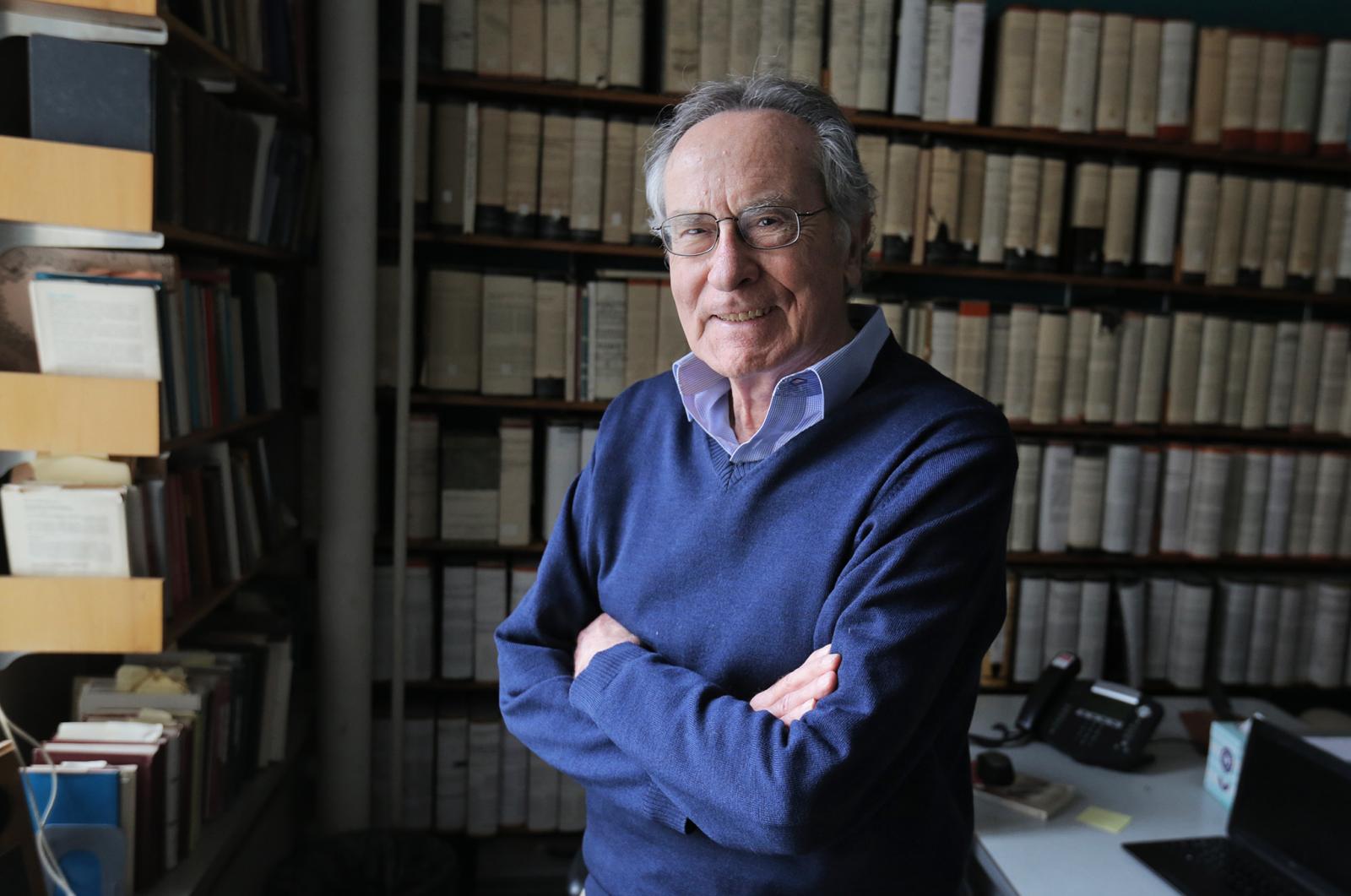
INVENTED ARTIFICIAL SKIN: MIT professor Ioannis V. Yannas, a physical chemist and engineer “known for the invention of artificial skin for the treatment of severe burns,” passed away in late 2025 at the age of 90. Dr. Yannas, affectionately called Yanni by colleagues, was also part of the Harvard-MIT program in Health Sciences and Technology. “His principle research interest throughout his career was the process of induced organ regeneration used to replace organs that are either severely injured or terminally diseased,” writes MITMechE. “His work also advanced the clinical use of collagen tubes to treat peripheral nerve injuries.
MATH MEDIC: Well before Google’s AI chief Demis Hassabis shared the Nobel prize in 2024 for his role in developing the Alpha Fold artificial intelligence tools that helped chemists map protein folding, mathematicians, computer scientists and physicists were being hotly recruited by the world of medicine. And what higher calling is there? Every single human being desires life extension or at minimum quality of life extension. In December, Stathis Megas became the latest machine learning scientist to join the pursuit of medicinal science. Armed with a Ph.D in pure mathematics and theoretical physics, Megas joined the faculty at the University of Vienna as a tenure-track assistant professor in the school’s biomedicine department.
AI & GREEK MYTHS: In December TechXplore ran a piece titled “How Greek myths and Hollywood hits can help us understand AI today.” They profile Nina Beguš. a researcher/lecturer who’s “making the case for a new way of teaching and thinking about AI,” explains TechXplore. Her new book “Artificial Humanities,” among many ancient lessons, addresses the Greek myth of Pygmalion, about a man who creates a statue of a woman and falls in love with the inanimate object. The author also invokes Daedalus who crafted “living bronze statues,” and the god Hephaestus, inventor of Talos, “an automaton that protected Crete from invaders.” Beguš takes a look at recent films “Ex Machina” and “Her” which “explore relationships between human protagonists and their AI creations, echoing stories from thousands of years ago,” writes TechXplore.
ROCK OF PHYSICS: Rockefeller University on January 7 posted a memorial to emeritus professor Konstantin Goulianos, 90, a renowned particle physicist. He graduated both Thessaloniki University and Columbia University, and was a member of the team that built the high-energy detector at Brookhaven National Laboratory, the facility that confirmed the existence of the muon neutrino. That event earned his thesis advisors a Nobel prize and Dr. Goulianos was honored to travel to the awards ceremony to witness history. He also worked on the teams at FermiLab that discovered the top quark, and CERN when when they discovered the long-elusive Higgs Boson.
SCIENCE SHERPA: Conservation biologist Haritakis Papaioannou, Ph.D, “has been involved in nature conservation and wildlife management for nearly 30 years, as a field researcher in projects for brown bear, Balkan chamois, amphibians, raptors, flora and Natura 2000 habitats,” according to his bio. In November, the journal Nature ran a feature on how he “combines a mountaineer’s know-how with a scientific eye to track the slow recovery of chamois populations in western Greece.” Dr. Papaioannou has also authored five books. Chamois (phonetically, shammy or shamwa) is a goat-antelope hybrid native to Europe.
OUZO EFFECT: It’s now officially a scientific term, and we don’t mean the hangover. In December, Phys.org published the headline “‘Ouzo effect’ reveals how oil droplets can resist flow and form stable patterns in liquids.” They go on to state “the aniseed oils contained in the spirit dissolve well in alcohol but not in water,” writes Phys. “The clear ouzo from the bottle has a high alcohol content at which the oil is fully soluble.” The research explains concepts of fluid flow and the milky appearance in watered-down ouzo. Let this be a lesson to never water down your ouzo! Sci-Psi is here for you, all in the name of science!
Terry Poulos is a writer, artist, and fractal geometer whose inquisitions focus on theoretical physics, mathematics, ancient and modern technology and archaeology. His art and musings can be found at Scientiquity.com and Scient iquity.medium.com

 Please wait...