


By Catherine Tsounis
The death of Lord George Gordon Byron at Missolonghi, Greece, during the Greek War of Independence was an event that resonated around the world like an earthquake. The subsequent Exodus of Missolonghi intensified international attention and sympathy for the Greek cause. Together, Byron’s death and the dramatic fall of Missolonghi sparked a powerful wave of Philhellenism across Europe and the United States. This surge of support played a crucial role in strengthening the struggle that ultimately led to the emergence of the modern Greek nation.
The Exodus of Missolonghi took place on April 10, 1826. This pivotal event in the Greek War of Independence is being commemorated by the European Parliament and the Greek Ministry of Education as part of the events marking the 200th anniversary of the Exodus of Missolonghi in 2026. It is estimated that approximately 3,000 Greek men were killed during the Exodus. In addition, around 6,000 women and children from the city were captured, enslaved, and sold in the slave markets of Constantinople and Alexandria.¹
Who kept the flame of their sacrifice alive for nearly two centuries? It was not a wealthy or powerful man. Theodoros Vrysakis was the son of a father who was publicly humiliated and hanged in 1821 during the early years of the Greek War of Independence. Orphaned along with his brother, he spent his childhood in an orphanage on the island of Aegina.
From these humble and tragic beginnings, Vrysakis created paintings that became lasting monuments to the Greek struggle for freedom after nearly four centuries of Ottoman rule. Through his art, he preserved the memory of sacrifice, heroism, and national identity. His works helped shape the historical consciousness and patriotic spirit of modern Greeks. Today, his paintings continue to be widely recognized and displayed during celebrations of Greek Independence Day on March 25, reminding each generation of the sacrifices that led to the birth of the modern Greek nation.
In 1832, probably with the help of Ludwig Thiersch, he went to Munich where he studied at the Panhellenion, the Greek school founded by Ludwig I for the orphans of the veterans of the Greek War of Independence. King Ludwig I of Bavaria (reigned 1825–1848) was a passionate philhellene who supported Greek independence, famously installing his second son, Otto of Greece (Otto I), as the first King of Greece (1832–1862). Ludwig funded the Greek cause, sent advisors and soldiers, and fostered strong Bavarian-Greek ties.1 Vrysakis ties in Munich and Bavaria, led to his financial support and independence.
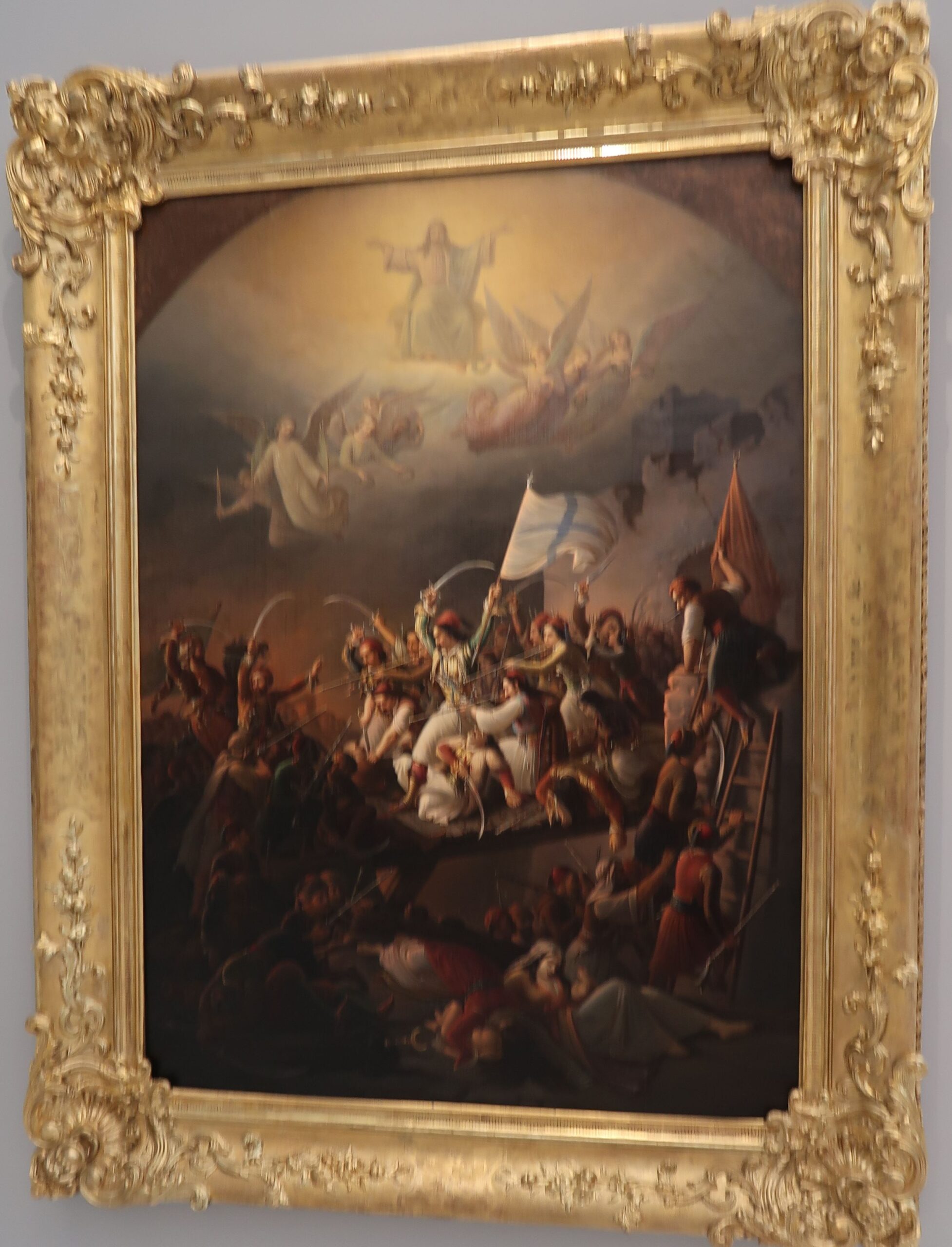
He received (1st prize at the International Exhibition of Vienna in 1853 for his work “The Exodus from Missolonghi”. His painting depicts the people of Missolonghi fighting their way out of the Ottoman siege during the night of April 10, 1826, an event known as the Exodus of Missolonghi. The composition portrays the violence and chaos of the battle while also conveying a powerful symbolic message.
In the heavenly section at the top of the painting, God is enthroned upon a golden cloud, blessing the fighters. Around Him, angels holding laurel leaves and wreaths prepare to crown the heroes. This imagery reflects the belief among the Greeks that their struggle for freedom was a just cause that enjoyed Christ’s blessing.
In the earthly section below, Greek fighters are shown on a wooden bridge brandishing their swords as they storm out through the city gate. One of them raises the Greek flag, bearing the cross on its staff. Some of the fighters are already wounded, while women and children follow behind them in desperation. Beneath the bridge, mothers and children have fallen into the ditch—some already dead, others dying.
Opposing them are the fully armed Ottoman soldiers waiting to confront the escaping Greeks, while others climb the city walls on ladders. Uproar, tension, and drama dominate the scene. The viewer can almost hear the clash of weapons and the cries of the wounded. Through its emotional intensity and heroic imagery, the painting reflects the powerful spirit of Romanticism.³
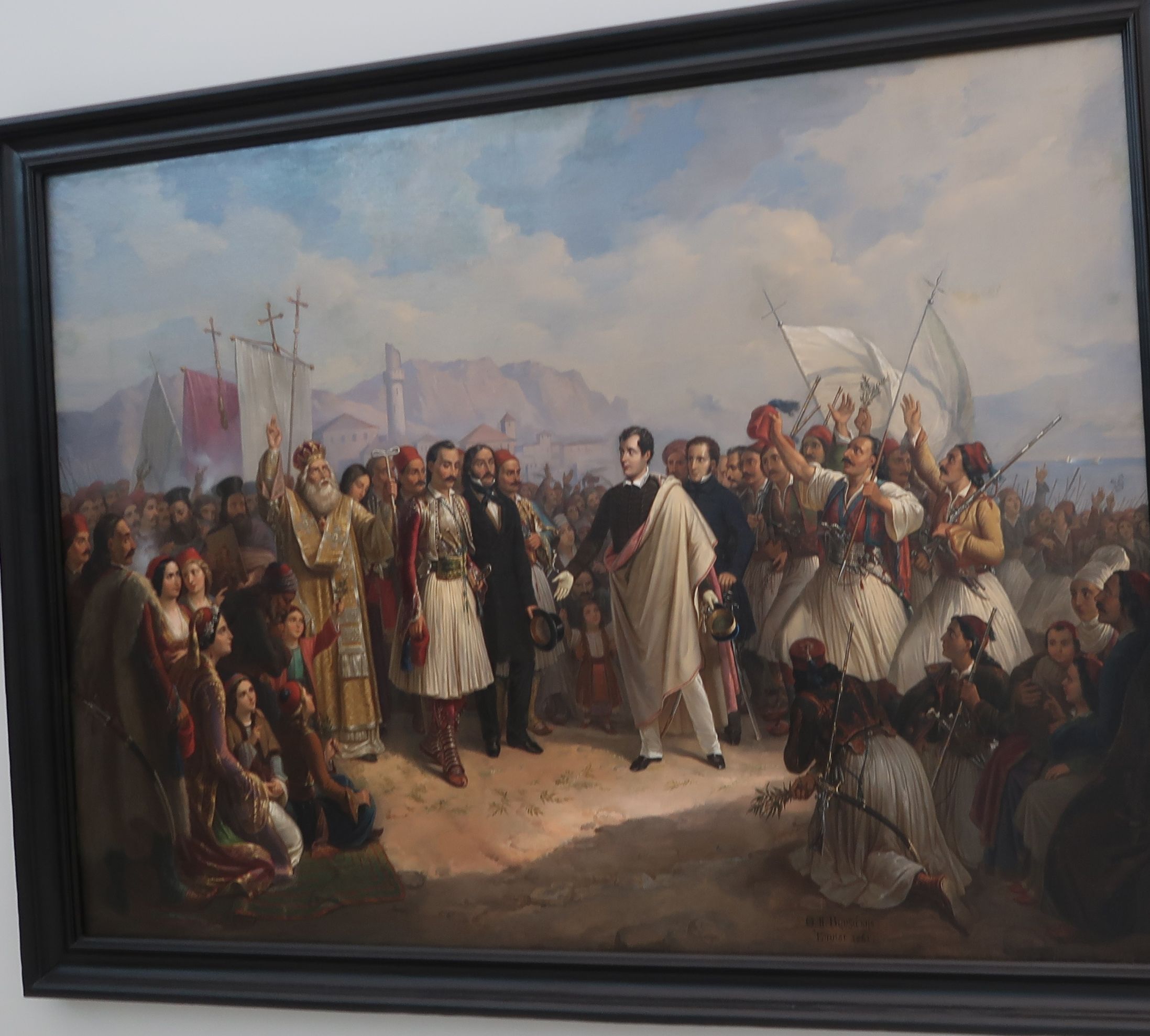
Theodoros Vrysakis second masterpiece depicting Missolonghi is The Reception of Lord Byron at Missolonghi. In 1823, Lord Byron—the most famous Philhellene—traveled to Greece to act as an agent of the London Philhellenic Committee, which had been formed to support the Greek struggle during the Greek War of Independence. He arrived by boat in January 1824 and was welcomed with great enthusiasm by the local population. In Vrysakis painting, Byron is portrayed in an almost messianic manner, emphasizing both his symbolic importance to the Greek cause and the deep admiration he inspired among the Greek people. On the 202nd Anniversary of Lord Byron’s death, we must remember him. He who had it all, giving up wealth and life. His heroic sacrifice inspired the creation of modern Greece.
Historical painting was intended to serve a pivotal political, ideological, and educational role. Its purpose was to preserve the memory of the heroes who struggled and sacrificed to achieve independence and secure the nation’s freedom after the long and painful period of Ottoman rule. The heroic figures and their sacrifices became powerful beacons of patriotism for future generations. Through his works, Theodoros Vrysakis nurtured and shaped the patriotic conscience of modern Greeks and their supporters.
All photos by Catherine Tsounis. Special appreciation to Erica and Doris for their tour of the National Gallery Alexandros Soutsos Museum, Athens, Greece.
References:
1. https://greekreporter.com/2025
3. https://www.nationalgallery.gr
Links:
https://www.greeknewsagenda.gr
Vryzakis Theodoros – National Gallery

 Please wait...