


Editor’s Note: The views expressed in this opinion piece are those of the author and do not necessarily reflect the views of Hellenic News of America.
Dear Friends,
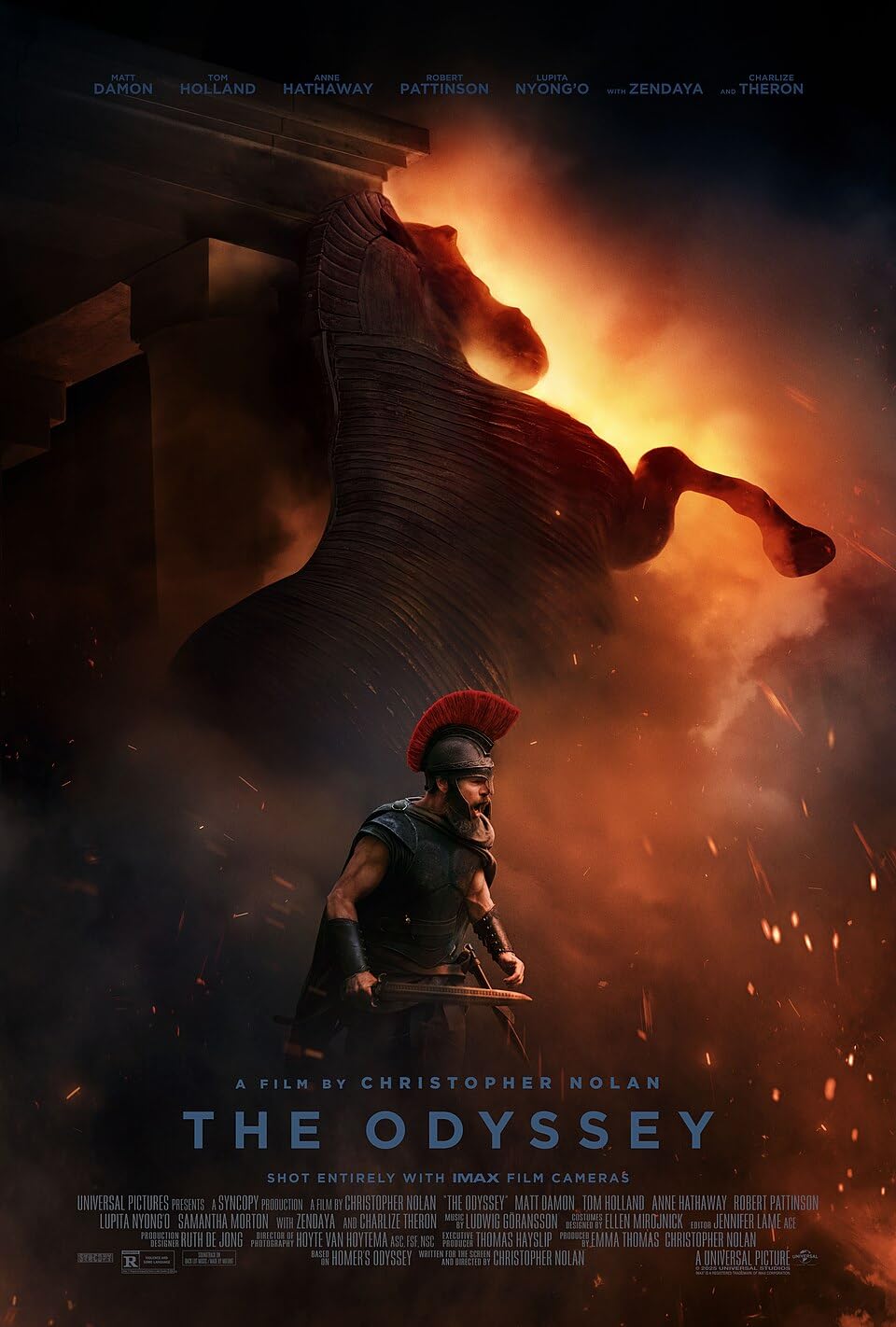
In an era of rising global conflict and friction, Christopher Nolan’s film adaptation of The Odyssey provides a vital opportunity for educators to revisit classical virtues like Metis (wisdom blended with craft), Kleos (glory—immortal fame), Xenia (hospitality), and Hybris (arrogant pride). While classicists are deeply polarized by Nolan’s choice to strip away traditional Hellenic philosophy in favor of modern wartime trauma, his radical departure offers professors, lecturers, and teachers a powerful modern mirror to analyze ancient values against contemporary geopolitical instability.
The Screen Culture Distraction: A Controversy Misplaced
Social media firestorms have focused heavily on Nolan’s casting of Lupita Nyong’o as Helen of Troy. Critics argue a Black Helen disrupts traditional visual imagery, while prominent classicists counter that complaining about the racial authenticity of a mythological figure is fundamentally missing the point. Noted translator Daniel Mendelsohn actually defended the casting, calling it a worthy way to “provoke, challenge and discomfit how we think about beauty and identity.”
The fixation on Helen’s skin tone ignores the far more significant subversion taking place. The real issue in Nolan’s film is not visual diversity, but a profound philosophical rewriting of the ancient Greek worldview. By applying 21st-century morality to Bronze Age dynamics, the screenplay systematically reengineers Homer’s text.
Metis Exchanged for Gritty Survivalism
This ideological shift is most evident in the erosion of metis—the clever intelligence blended with craft and strategic self-restraint that defines Homer’s Odysseus. In the epic, Odysseus is a master trickster who uses verbal irony and elaborate disguises to outmaneuver gods and monsters alike.
As noted in a Harvard Graduate School of Arts and Sciences analysis, Homer’s original text uses Odysseus’s shifting identity to explore complex thematic “ambivalence and ambiguity.”
Mendelsohn observed in his critique that Nolan instead gives audiences an Odysseus with “no cleverness, no humor, no wily charm.” One of the Western canon’s formative tricksters has been transformed into a haunted protagonist. Matt Damon’s Odysseus does not rely on linguistic manipulation or tactical deception; instead, his metis is reduced to a grim, protocol-driven survival instinct.
The Death of Kleos: Trading Glory for Guilt
Similarly, the film rejects the concept of kleos—the immortal glory achieved through great heroic deeds, which served as an ancient Greek’s shield against the finality of death. In Homeric culture, achieving kleos justified the immense violence of war.
Nolan treats the pursuit of glory with intense modern skepticism. In this adaptation, the sack of Troy is framed as an agonizing war crime that leaves Odysseus deeply traumatized, turning a moment of mythic triumph into a source of profound moral shame. Rather than fighting to secure his legendary status, Damon’s Odysseus spends the film running away from it, trading the ancient pursuit of fame for a contemporary quest for personal penance.
Xenia Diluted: The Collapse of Cosmic Justice
Finally, this modern psychological restructuring alters xenia, the sacred ancient law of guest-friendship. In Homer’s world, xenia was a divine mandate protected by Zeus, serving as a fundamental metric of human civilization. The original narrative architecture builds its stakes entirely around violations of this code—from the suitors eating Odysseus out of house and home to the Cyclops devouring guests.
Nolan’s film destabilizes these clear moral boundaries. By removing the coercive, seductive dynamics of figures like Circe and Calypso, the script reframes them as sympathetic caretakers assisting Odysseus with his memory recovery. While this gives the female characters a deeper human dimension, it simultaneously dilutes the cosmic stakes of the narrative. When the spiritual weight of xenia is minimized, the suitors stop looking like transgressors against divine law and start looking like mundane political rivals.
A Silver Lining for Educators: A Modern Mirror for Ancient Values
Despite these severe creative departures, critics may be overlooking the film’s immense educational value. In an era defined by intense global uncertainty, military frictions, and international conflicts, Nolan’s adaptation provides professors, lecturers, and school teachers with an unprecedented pedagogical baseline.
By holding Nolan’s traumatized Odysseus up against Homer’s original texts, educators can engage students in vital conversations about how ancient pillars like Metis, Kleos, and Xenia translate to modern warfare. Crucially, the film serves as a stark warning against Hybris (outrageous pride or arrogance). In a world currently fractured by geopolitical instability, analyzing Nolan’s flawed hero allows the next generation to revisit these classical virtues not as dead literary terms, but as active, necessary frameworks for navigating modern global crises.
Conclusion: A Masterful Spectacle, an Educational Catalyst
Christopher Nolan has undeniably delivered an extraordinary piece of cinema, utilizing sweeping 70mm IMAX visuals to vividly convey the physical toll of a ten-year maritime voyage. However, by centering the film entirely on contemporary trauma and Western individualism, the adaptation fundamentally sacrifices the core philosophy of its source material. The production successfully crafts a compelling portrait of a broken modern soldier, but leaves the true spirit of Homer’s calculating, immortal glory-seeking king behind in the ancient dust.
Yet, it is precisely within this philosophical divide that the film finds its greatest cultural utility. Nolan’s The Odyssey offers a magnificent opportunity for educators to invite students into the classroom to dissect these profound differences. By confronting a Hollywood adaptation that strips away historical Hellenic pillars, teachers can challenge the next generation to deeply re-examine Metis, Kleos, Xenia, and Hybris, ensuring these ancient virtues remain vital tools for understanding human behavior in our own fractured, uncertain world.
About the Author
Ergini Batistatou-Martnishn serves as Vice Chair of the Hellenic Center in Washington, D.C. Her writing explores Hellenic culture, classical education, and the enduring relevance of ancient Greek thought in contemporary society.

 Please wait...