


As published in the Startups in Greece Report 2024-2025
THE GENDER GAP IN FINANCING
According to the Startups in Greece Report 2024-2025, in 2024 over 90 companies were funded with more than 555 million euros. However, only 24% of these companies had a woman among their founders, and there were only 4 all-female founder teams. Data from the European Investment Bank’s Economics Department in 2023 reveals that only 2% of invested capital went to all-women founding teams, while mixed teams received 5%. An astonishing 93% of funding was directed towards men-only teams. These numbers have slightly changed over the past decade, although there is a slight improvement in Greece compared to the previous years (18% in 2023).
This disparity has significant consequences, including missed economic potential, reduced innovation, and the perpetuation of gender stereotypes, among other issues.
WHY DOES THIS GAP PERSIST?
To gain deeper insights into this imbalance and identify possible solutions, Found.ation partnered with WE LEAD to organize two focus groups; one with women founders from Greece and abroad, actively engaged in various stages of fundraising, and another with investors, both men and women, who have a proven track record of investing in Greece and beyond.
Here’s what they shared!
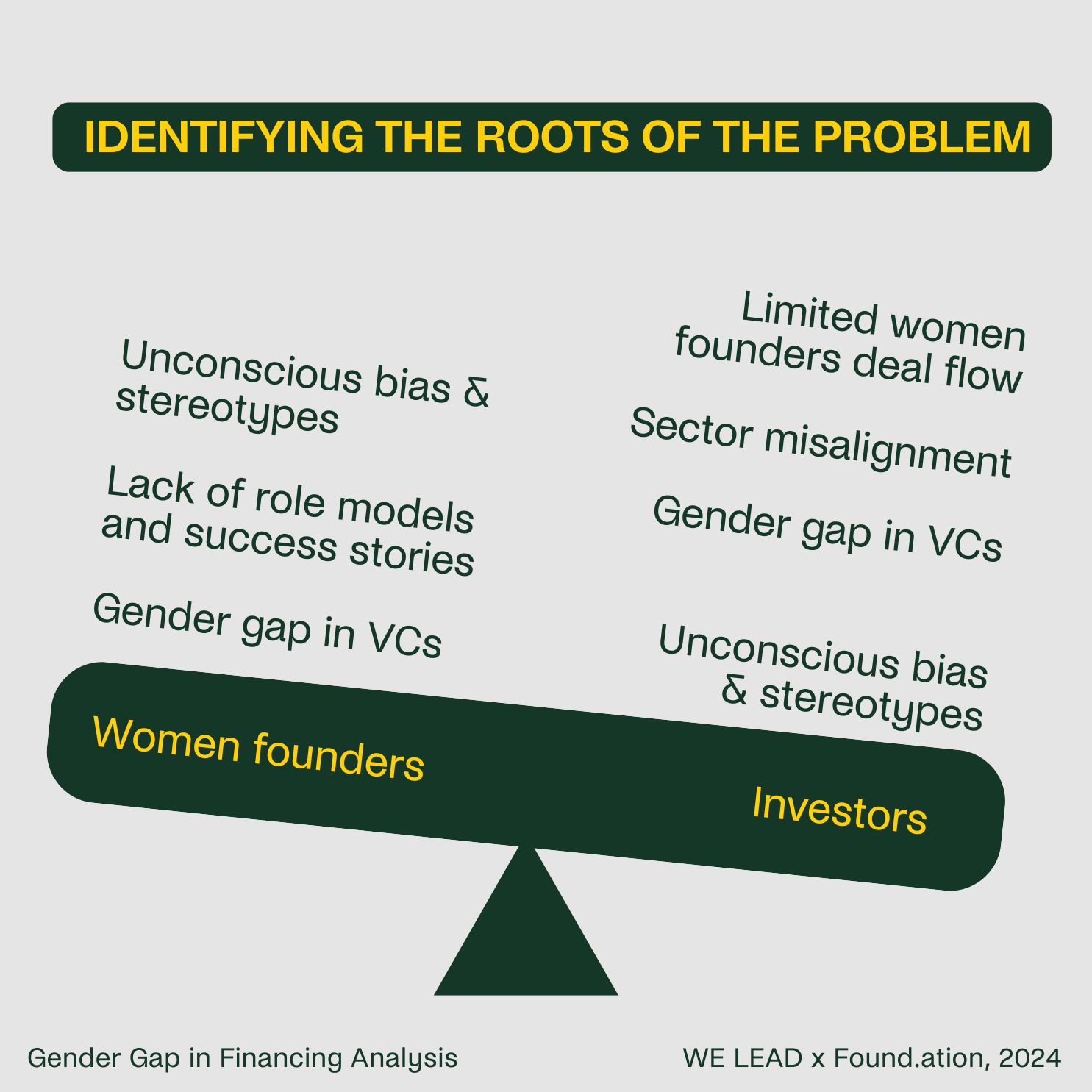
IDENTIFYING THE ROOTS OF THE PROBLEM
WOMEN FOUNDERS
- Unconscious bias and stereotypes: The number one reason that came up as a cause of the gender gap in financing by women founders was unconscious bias and stereotypes. Most agreed that while some progress has been made, women are still often not seen as capable founders, especially in terms of technology and finance issues, and that it still helps if there is a man on the team i.e. a man CTO. As it was mentioned during the discussion “there were cases where they needed to “prove their technical competence”. It was also mentioned that an investment to a woman founder might be seen as a more risky one, regardless of their experience, leading to often looking for reasons to reject them.
- Lack of role models and success stories: Another reason for that is that there are not enough examples of successful women founders. As it was mentioned during the discussion, “the more they see women founders and successes, the more they can associate investing in women founders as a choice with lower risk”. Some participants also highlighted that when women founders fail, the negative impact on their future fundraising efforts tends to be more pronounced compared to men. This leads to a situation where failed women-led ventures create a lasting bias in the minds of investors, who may then unfairly compare other women founders to these cases.
- Gender gap in VCs: Many participants highlighted that the lack of women in decision-making positions within VC firms contributes to the problem. This gap leads to a narrower perspective on the types of businesses and founders they are willing to support.
INVESTORS
- Limited women founders deal flow: Investors consistently mentioned that a major root cause of the gender gap in financing is the low number of women founders approaching them for funding. For many investors, women are simply not showing up in significant numbers. According to many of them, the cause of this lies in education, starting with schools and universities. Specifically, girls and young women are not introduced to STEM or entrepreneurship, leading to lacking skills such as financial literacy, tech acumen, resilience and risk taking. However, it’s important to also note that women investors specifically targeting women founders offer a different perspective. They argue that they see more women in their deal flow and suggest that women founders may not feel comfortable approaching all- men or majority-men investor teams.
- Sector misalignment: Investors pointed out that women founders often focus on sectors that are out of the VC radar compared to technology. This sector misalignment reduces the likelihood of women getting funded, as many investors are more interested in tech startups, where fewer women participate.
- Gender gap in VCs: the lack of senior women partners in venture capital can discourage women founders from seeking funding or feeling like they “fit” with potential investors. This gender gap, both in VCs and women-founded startups, creates a reinforcing cycle: with fewer women founders receiving funding, there are fewer opportunities for them to achieve successful exits and later reinvest as angel investors or venture capitalists.
- Unconscious bias and stereotypes: While many participants mentioned that unconscious bias and stereotypes exist this was not seen as the central or driving issue behind the gender gap. Instead, it was viewed as a secondary factor that worsens the problem but does not solely account for the disparity.
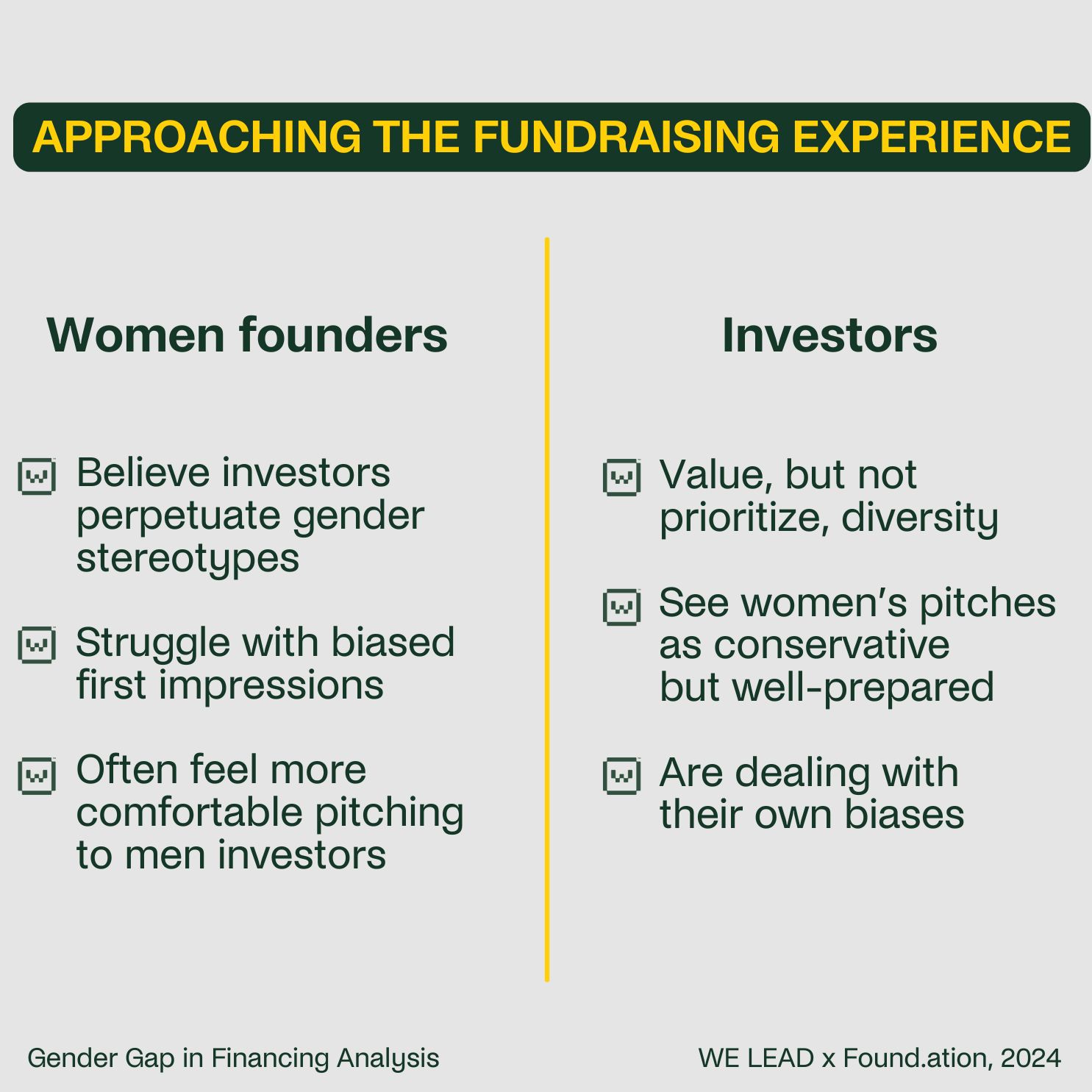
APPROACHING THE FUNDRAISING EXPERIENCE
WOMEN FOUNDERS
- Dealing with gender stereotypes: Women founders often face questions unrelated to their business, such as inquiries about family plans, marriage, or motherhood, which male founders typically do not encounter.
- Challenges with first impressions: Several women highlighted that the first moments of an investor meeting are critical, as they often face prejudice based on their appearance or gender. Furthermore, some founders noted that if they approach investors with a friendly or approachable way, they are seen as “sweet girls” and not serious entrepreneurs, which has a negative impact on their fundraising efforts. That’s why many believe that “warm intros” can be crucial, as they help set a more favorable tone and mitigate initial biases.
- Pitching to women vs men investors: Some women founders mentioned that they prefer pitching to men investors over women investors. As highlighted, women investors can be more strict and detail-oriented in general, and they may not want to be seen as favoring another woman. The group argued that this behavior might be caused by the effort women investors put to prove their worth, too, in a men dominated environment. Men investors were described as more predictable – as women founders understand how to approach and manage them due to their prior experiences – yet they’re more biased.
INVESTORS
- Importance of gender diversity in investment decision: Regarding gender diversity in teams, most investors agreed that mixed teams are better in terms of performance, and some associated women with better results and healthier cross-team relationships. However, many of them admitted that this is not a priority for them. Diversity is welcome but not imposed, and men-only teams will not stop them from an investment. On the other hand, some investors mentioned that women are seen as “hungry underdogs,” and there is a significant business opportunity in investing in them.
- Pitch style differences: It was also noted that men tend to present their business potential more aggressively or optimistically, while women often take a more conservative approach in their pitches, even when reaching out to investors. This can make them appear less ambitious, potentially putting them at a disadvantage when competing for funding. However, many agree that women tend to be more prepared and structured in their presentations.
- Dealing with their own biases: Although bias wasn’t the main concern discussed, many investors mentioned that they are working to diversify their teams. Some are also starting to track metrics within their portfolios to better understand how unconscious bias may be influencing their investment decisions.
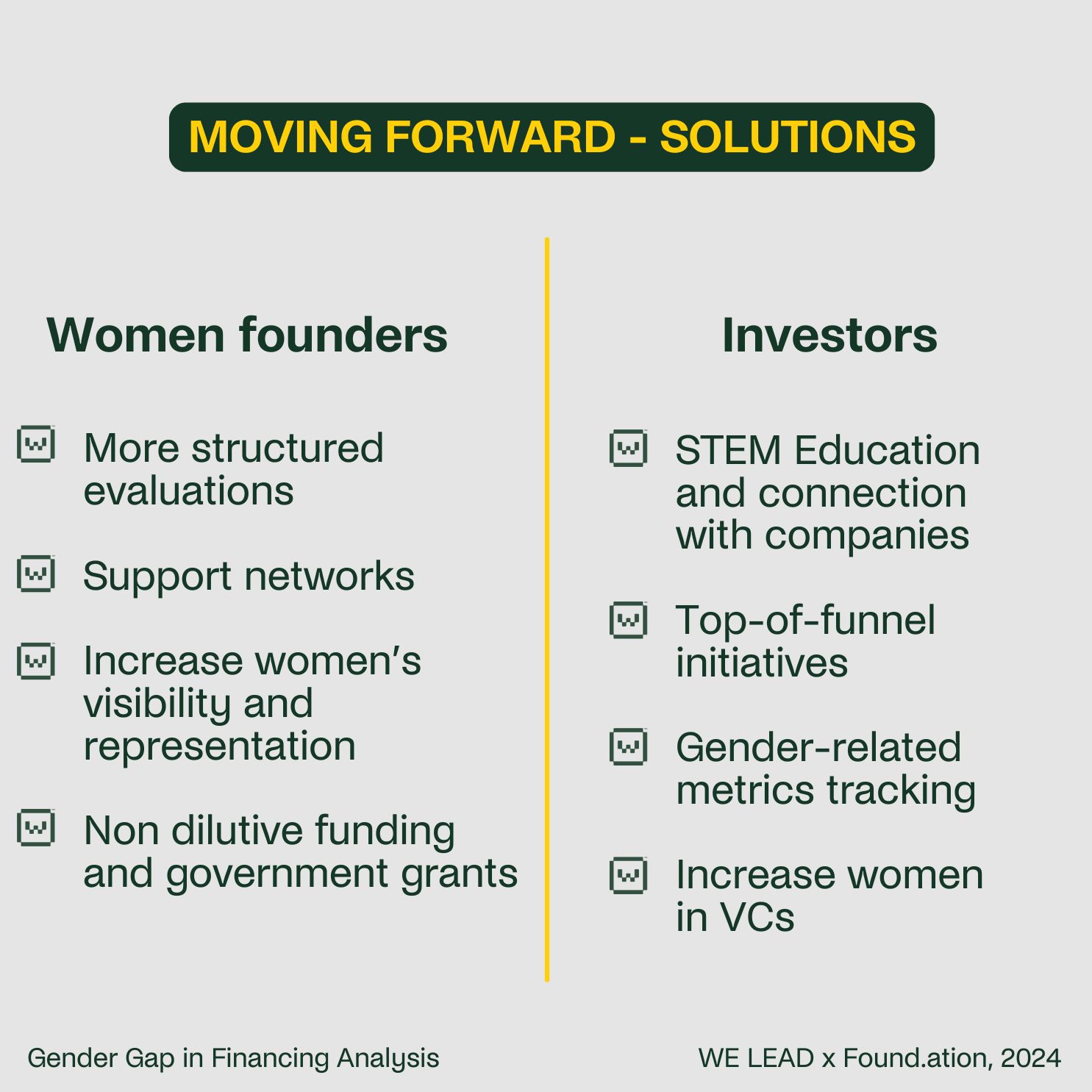
MOVING FORWARD – SOLUTIONS
WOMEN FOUNDERS
- Mentorship, trainings and support networks: Participants emphasized the importance of mentorship programs, where experienced women founders mentor newer ones, as well as peer-to-peer support. They also argued about the necessity of more practical training for women founders, learning how to address common problems in entrepreneurship and challenges during the fundraising process. Some participants also highlighted the need to strengthen women-to-women collaborations, including making introductions and uplifting one another, to foster a more supportive and connected ecosystem.
- Increasing representation: To address the gender gap, many participants suggested that increasing visibility for successful women founders is key. This includes more media coverage and public speaking opportunities. As more success stories of women-led startups emerge, investor perceptions may gradually shift, making women founders appear less “risky”. Additionally, this visibility can inspire and encourage more young women to pursue careers in entrepreneurship and technology.
- Non-dilutive funding and government grants: Another solution was to create more access to non-dilutive funding, such as government grants specifically targeting women founders. This could help women de-risk their ventures and develop more robust business cases before approaching VCs, making them more competitive and less dependent on equity investment.
- More structured evaluations: Some founders advocated for the importance of investors adopting more methodology-driven approaches in hiring and investment decision-making. Several women in the group highlighted how structured evaluations, such as take-home case studies, allowed their skills and competence to stand out, particularly when compared to less-prepared male counterparts.
INVESTORS
- Increasing the top of the funnel through targeted initiatives: Several investors emphasized increasing the top of the funnel as key to bridging the gender gap in financing. They suggested encouraging more women to start companies earlier, boosting outreach, and collaborating with women-focused forums. Some noted that sectors like life sciences and biotech have better gender balance, and expanding investment there could bridge the gender gap. While mentoring was seen as valuable, some argued it’s insufficient without direct funding, which is essential for women founders to make real progress.
- STEM Education and connection with companies: Following the previous point, many of the investors focused on education, suggesting more engagement with companies and entrepreneurship, deeper focus on financial literacy, computers and coding.
- Data-driven approach: They also discussed the need for self retrospection and a better understanding of the disparity’s whys. Specifically, several participants suggested that tracking gender-related metrics (e.g., the diversity of teams in their portfolios) and openly sharing these numbers could help raise awareness and create a push for more gender-inclusive funding. Tracking could also provide insights into which part of the investment process most women are being rejected. Some investors have already taken or are planning to take this step.
- Increasing representation of women partners in VCs: There was strong agreement that more women investors and diverse investment teams would help bridge the gender gap.
WE LEAD VIEW
If there is one key takeaway from these discussions, it is that such dialogues should occur more frequently. While progress has been made, women continue to face unique challenges, from proving their technical competence to being perceived as higher-risk investments. Through discussions with both groups, gaps and blind spots have emerged in how women founders and investors perceive women’s representation, discrimination, the reasons for the gender gap, and potential solutions. Although both groups share similar experiences in meetings and pitches, they navigate these environments with different backgrounds, perspectives, and biases. To address these biases and other factors contributing to the underrepresentation of women, it is essential to come together and first agree on the nature of the problem.
At WE LEAD, we believe that bridging the gender gap in financing and having more women trailblazers isn’t just a matter of fairness; it’s about unlocking untapped potential that will benefit the entire entrepreneurial landscape. This leads to innovations that are inclusive of all people, regardless of gender, while delivering greater value to the investor community through both capital and talent. We are committed to driving real, actionable change, starting now.
About WE LEAD
WE LEAD is an independent nonprofit organization founded by Libra Philanthropies in 2023 to create a pathway for women – cisgender and transgender – to reach leadership positions. Starting with the technology sector, one of Greece’s fastest growing industries and the driving force behind all changes around us, WE LEAD offers participants essential business and tech skills development, mentorship, job opportunities and networking, aiming to create equal opportunities for women to shape the future of everything. For more information visit: www.joinwelead.org


 Please wait...