
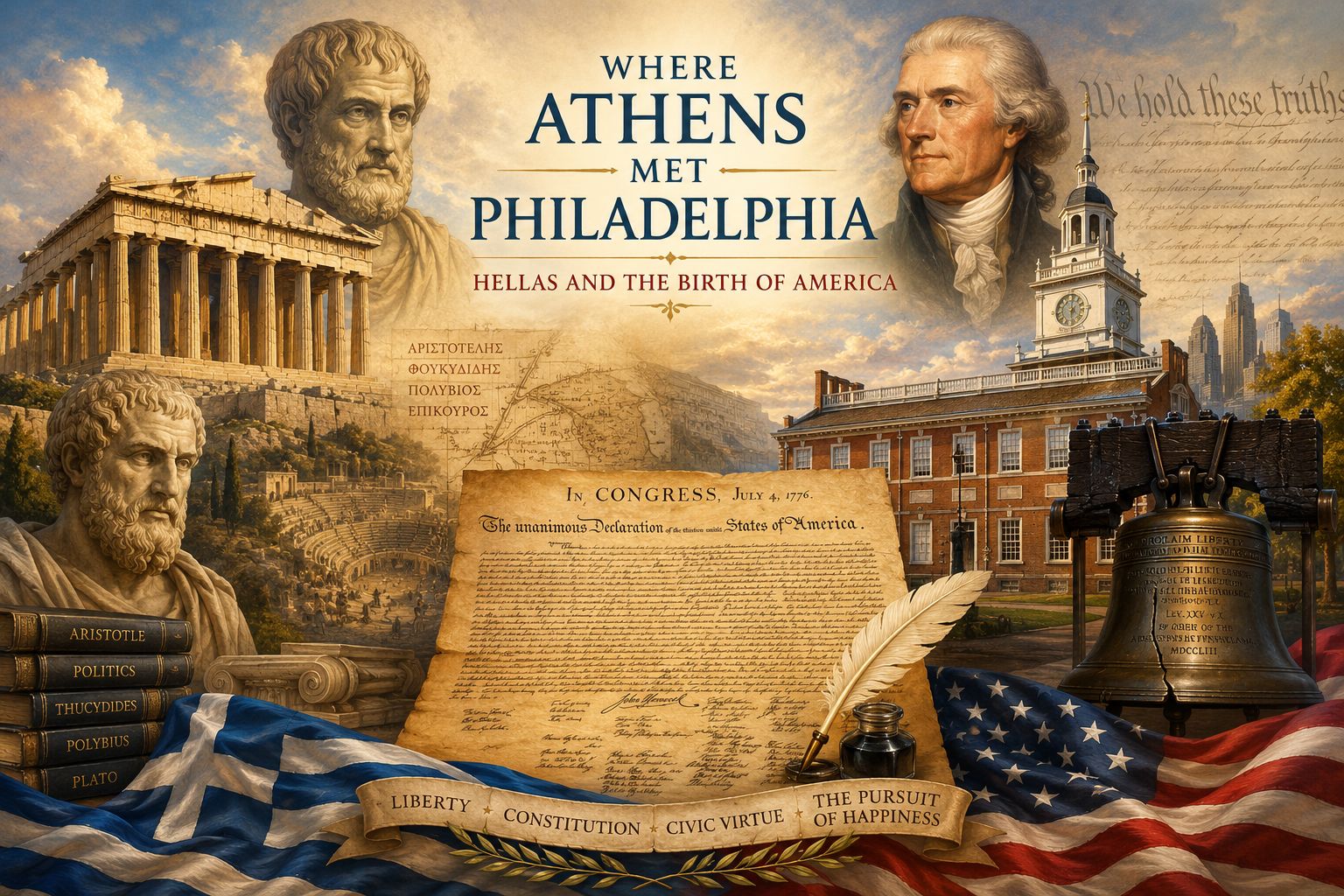

As the United States approaches the 250th Anniversary of the Declaration of Independence in 2026, Americans will celebrate the extraordinary generation that forged a republic dedicated to liberty and constitutional government. Yet often overlooked is the profound Hellenic influence that helped shape the ideas, institutions, and even survival of the American Revolution.
The Founding Fathers did not create America in an intellectual vacuum. They looked deeply to Classical Hellas for guidance, inspiration, and warning. From Aristotle and Thucydides to Polybius and Epicurus, Hellenic thought permeated Revolutionary America.
Among the most influential figures was Aristotle. His Politics profoundly shaped the American understanding of constitutional order. Aristotle’s belief in the rule of law became foundational to the United States Constitution, a government “of laws, and not of men.” His concept of a mixed regime blending monarchical, aristocratic, and democratic elements inspired America’s separation of powers and system of checks and balances.
Equally important was Aristotle’s idea of the common good: that government exists to serve society as a whole rather than the private interests of rulers or factions.
Yet the Founders also studied the failures of the Hellenic city-states. Though they admired Athens for its brilliance, they feared direct democracy and mob rule. James Madison famously warned in Federalist No. 55: “Had every Athenian citizen been a Socrates, every Athenian assembly would still have been a mob.”
Thucydides’ account of the Peloponnesian War deeply influenced the Founders’ fear of factionalism and civil discord. Madison drew heavily from these lessons in Federalist No. 10, arguing that a large republic could better restrain the “violence of faction” that destroyed so many Hellenic city-states.
The failures of ancient Hellenic confederacies also shaped the Constitution itself. Hamilton and Madison studied the Amphictyonic and Achaean Leagues as examples of weak federations unable to preserve unity because their member states retained excessive sovereignty. These lessons helped persuade the Founders to replace the weak Articles of Confederation with a stronger federal union.
Polybius likewise influenced American constitutional thinking through his theory that governments naturally decay into tyranny, oligarchy, and mob rule unless balanced by institutional safeguards. America’s checks and balances were designed partly to prevent this destructive cycle.
Even the language of the Declaration of Independence bears Hellenic echoes. Thomas Jefferson, influenced not only by John Locke but also by Hellenic philosophical traditions, replaced “life, liberty, and property” with the more expansive phrase “life, liberty, and the pursuit of Happiness”, reflecting a Hellenic understanding that political society exists to allow human flourishing and virtue.
The broader Hellenic ideal of civic virtue also shaped Revolutionary America. Like the Ancient Hellenes, the Founders believed republics survive only when citizens possess discipline, sacrifice, moral character, and devotion to the common good. Even Sparta influenced Revolutionary thinking, symbolizing endurance, patriotism, and sacrifice during hardships such as Valley Forge.
Hellenic language, literature, rhetoric, and history became central to early American education. Institutions such as Harvard University and College of William & Mary emphasized classical studies because republican leadership was believed to require immersion in Hellenic thought. Revolutionary speeches and pamphlets likewise reflected the rhetorical traditions of Demosthenes and the great Hellenic orators.
Even the symbolism of the new republic consciously echoed the ancient world. American civic architecture, political vocabulary, and public imagery drew heavily from Greco-classical models. The United States saw itself as heir to the ancient struggle between liberty and tyranny.
There was also limited but historically real Hellenic involvement connected directly to the Revolution.
One of the earliest Hellenic communities in North America was established at New Smyrna in 1768 by settlers from regions such as Mani and Crete. While the Hellenic settlers of New Smyrna did not fight for American independence and ultimately became dependent upon British protection in St. Augustine, their 1776 revolt against the brutal Turnbull plantation system helped collapse one of Britain’s major colonial enterprises in East Florida during the Revolutionary era, indirectly contributing to the instability and disruption that accompanied the wider conflict. More directly tied to the war itself was Michel Dragon, born Michael Dracos in Athens around 1739. Dragon fought in Spanish military campaigns allied with the American cause, participating in operations at Baton Rouge, Mobile, and Pensacola under Governor Bernardo de Gálvez. He eventually rose to the rank of lieutenant and remains one of the clearest documented Hellenes connected to the Revolutionary struggle.
One of the most fascinating Hellenic connections to the Revolution may be Margaret Kemble Gage, wife of General Thomas Gage brought up by Dr. Constantine Hadzidimitriou in one of our close to 20 lectures in our 205/250 Lecture Series at the Stathakion Center related to the Greek Independence Day Parade in New York that I was honored to Chair this year.
Margaret possessed direct Hellenic ancestry through her grandmother Elena Mavrocordato, a member of the prominent Phanariot Greek Mavrocordato family from Chios. Her grandfather served as British consul in Thessaloniki, while her father was born in Smyrna before immigrating to the colonies.
Historians have long suspected that Margaret may have secretly warned Patriot leaders of British troop movements before Lexington and Concord in April 1775, the moment immortalized in the phrase “the British are coming.” While definitive proof remains elusive, many scholars consider her one of the strongest candidates for the mysterious informant.
Another Hellenic American connected figure within the Founding era was John Paradise (also brought up by Dr. Hadzidimitriou) , born in Thessaloniki to a Hellenic family and later associated with Thomas Jefferson, reinforcing Jefferson’s engagement with Hellenic language and classical thought.
Yet Hellenic influence extended beyond philosophy and politics.
It also helped save the Revolution itself.
During the Revolutionary War, smallpox posed and proved deadlier to the Continental Army than many British weapons. Historians estimate that thousands of Patriot soldiers, possibly between 5,000 and 10,000, died from the disease during the Revolution, making George Washington’s decision to inoculate the army one of the most consequential medical actions in American history. In 1777, George Washington ordered the mass inoculation of the Continental Army using variolation, an early precursor to vaccination that dramatically reduced mortality and helped preserve the revolutionary cause.
The origins of this knowledge reveal another extraordinary Hellenic connection.
Decades earlier, Lady Mary Wortley Montagu encountered variolation while living in Constantinople, where she observed elderly Hellenic women performing the procedure as part of local Hellenic folk medicine traditions. She later introduced the practice to Britain after entrusting her own son to inoculation performed by a Hellenic woman.
Before Lady Mary popularized variolation, two Hellenic physicians from the Ottoman world, Emmanuel Timoni and Jacobus Pylarinos, had already scientifically documented the practice. Educated in Italy and working within Hellenic communities of the eastern Mediterranean, they submitted pioneering papers to the Royal Society of London explaining the effectiveness of inoculation.
Importantly, Timoni and Pylarinos openly acknowledged that the knowledge had long been preserved through the practical experience of Hellenic women. Their work became some of the earliest scientific discussions of immunization in modern Western medicine and helped open European minds to inoculation, knowledge that would eventually influence Washington’s lifesaving decision during the Revolution.
As America approaches its Semiquincentennial, these connections deserve renewed attention.
The United States was shaped not only by Enlightenment thinkers and English constitutional traditions, but also by a deeper Hellenic inheritance that profoundly influenced the philosophy, structure, civic ideals, education, rhetoric, and survival of the American Revolution itself.
From Aristotle and Thucydides to Michel Dragon, Margaret Kemble Gage, Emmanuel Timoni, and Jacobus Pylarinos, Hellenism helped shape both the mind and endurance of the American Republic.
At 250 years, the American Declaration of Independence stands not only as an American achievement, but also as part of a broader civilizational continuum in which the legacy of Hellas helped illuminate the path toward liberty.
As a Hellenic American whose ancestors did not directly fight in the American Revolution, I nevertheless feel strongly, as many Hellenic Americans do, a very deep connection to the spirit of 1776. The ideals that gave birth to the American Republic were profoundly shaped by the intellectual and civic legacy of Hellas. Liberty, constitutional order, civic virtue, sacrifice, and resistance to tyranny form part of both the American and Hellenic historical experience. In that sense, the story of the American Revolution has also become part of our own shared inheritance that we have come to treasure.
ΖΗΤΩ Η ΕΛΛΑΣ and GOD BLESS AMERICA !!
Lou/Ilias Katsos

 Please wait...