

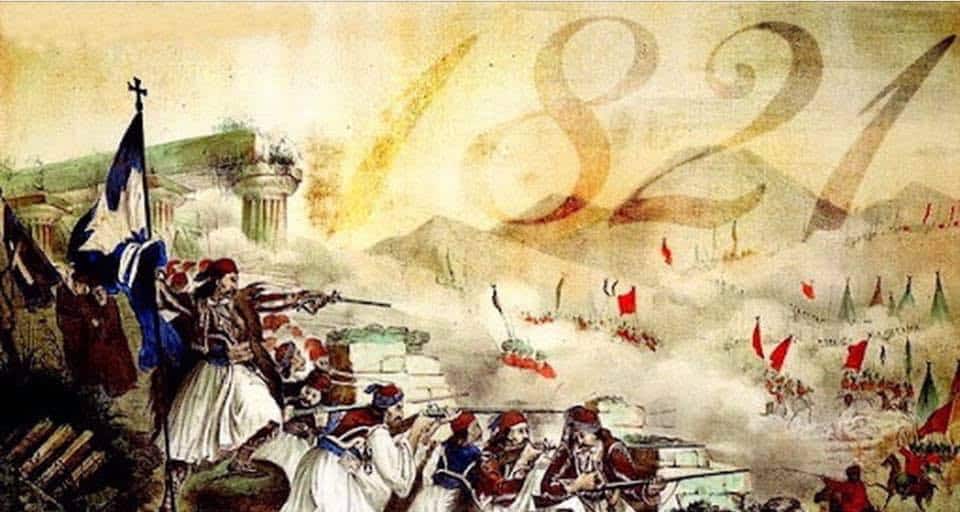

The Greek fight for independence from Ottoman rule officially began on March 25, 1821, at the monastery of Hagia Lavra in Kalavryta. There, Bishop Germanos of Paleon Patron raised the revolutionary banner, setting the stage for a movement that would change the course of Greek history. This date was especially meaningful as it coincided with the Annunciation of the Theotokos, a significant religious holiday for Orthodox Christians. However, the seeds of the revolution had been sown long before this moment, with many unsuccessful uprisings that had freed some Greeks from Ottoman rule over the years.
For 400 years, the Greek people endured oppression and hardship under Ottoman control. Denied proper education, many Greeks lived in ignorance and superstition, with their cultural identity suppressed. Despite this, the spirit of resistance never died. Small uprisings led by the kleftes (guerrilla fighters) and armatoloi (military leaders) kept the flame of freedom alive. The church, often the only institution that could operate freely, secretly ran Krifo Sxolio (Hidden Schools), where children learned to read and write, preserving the Greek language and history in the face of tyranny.
One of the key figures in the Greek War of Independence was Alexander Ypsilantis, a man who embodied both the hopes and challenges of the revolution. Born into an aristocratic family in 1792, Ypsilantis was well-educated and served as an officer in the Russian Imperial Army. It was his military training and his passion for his homeland that led him to become one of the early leaders in the struggle for freedom. In 1814, Ypsilantis became a member of the Filiki Eteria (Society of Friends), a secret society founded to liberate Greece from Ottoman rule.
When the revolution began, Ypsilantis led an army in Moldavia, hoping to spark a widespread uprising. Though his campaign failed, with his forces defeated and forced to retreat, his actions were far from in vain. Ypsilantis’s bravery and sacrifice drew the world’s attention to the Greek cause, and his bold attempt at liberation became a powerful symbol for the revolution. As he famously said, “The future of Greece is at stake. If we do not rise now, we will forever remain subjugated, forgotten by history.” His determination sparked a chain of events that would eventually lead to Greece’s independence.
The role of Greek islanders in the revolution cannot be overstated. Islands like Spetses, Hydra, and Chios provided the maritime strength and financial support critical to the revolution’s success. The Greek merchant fleet, despite the challenges posed by the Ottoman Empire, was able to bring European ideas of democracy and freedom back to the Greek people. It was the Greeks’ international connections that helped spread their struggle for independence to the world.
One of the most famous figures to join the Greek cause was Lord Byron, the English poet who was captivated by Greece’s fight for freedom. He once said, “I have been in love with Greece since I was a child, and I am determined to die for her.” Byron’s passion for Greece was infectious, and his death in battle made him a martyr for the cause. Similarly, American physician Dr. Samuel Gridley Howe, who joined the fight, declared, “In the cause of Greece, I feel that I am not just fighting for a country but for the freedom of mankind.” These words resonated deeply with those who supported the revolution, and their dedication helped to keep the movement alive.
Ypsilantis may have been one of the first to sacrifice for the cause, but his legacy lives on in the hearts of the Greek people. His words, “The future of Greece is at stake. If we do not rise now, we will forever remain subjugated, forgotten by history,” continue to inspire generations of Greeks who cherish their independence and heritage. The Greek War of Independence was not just a battle for land, it was a battle for the very soul of the nation, and the sacrifices made by countless individuals ensured that Greece would one day be free.

 Please wait...