



By Catherine Tsounis
Who is the saint admired by both Eastern and Western Christianity? It is St. Nicholas of Myra, whose relics are housed in the underground crypt of the Basilica di San Nicola in Bari, Italy. I had the unique opportunity to visit Southern Italy—Magna Grecia—during an excursion from the provincial city of Tripolis, in the heart of the Peloponnese, Greece. Our tour guide, Konstantina Savvopoulou, together with Costa Tsioros and Maria Papalou of Tsioros Travel Agency, made this nearly seven-day tour possible for under 1,000 euros (about 1,050 U.S. dollars) in June–July 2025. The highlight of the trip for me was visiting the crypt of St. Nicholas of Myra—known today as Santa Claus.
Who is the saint revered by both Eastern and Western Christianity? It is St. Nicholas of Myra, whose sacred relics rest in the underground crypt of the Basilica di San Nicola in Bari, Italy. I had the unique opportunity to visit Southern Italy—Magna Grecia—during an excursion from the provincial city of Tripolis, in the heart of the Peloponnese, Greece. Our tour guide, Konstantina Savvopoulou, along with Costa Tsioros and Maria Papalou of Tsioros Travel Agency, made this seven-day tour possible for under 1,000 euros (about 1,050 U.S. dollars) in June–July 2025. The highlight of the journey for me was visiting the crypt of St. Nicholas of Myra—known today as Santa Claus.
St. Nicholas was born in 270 A.D. in Patara, Turkey. He was known for his life of generosity and compassion as the Bishop of Myra. He became the patron saint of children, sailors, merchants, prisoners, students, and all people. He was buried in Myra in 343 A.D. During the Eastern Roman (Byzantine) period, his tomb became a major center of religious pilgrimage. As the Byzantine Empire declined, many of its treasures and important Christian relics were seized and taken to the West. There are differing accounts of how the bones of St. Nicholas were transferred from Myra to Bari, in the region of Apulia in 1087 A.D.
The Seljuk Turks conquered and destroyed many Greek cities in Asia Minor. The tomb of St. Nicholas in Myra was in danger. In 1087 A.D., there was no country called Italy. People were loyal to their own seaports, cities, and regions that had once been part of the Byzantine Empire.
Bari, on the Adriatic Sea, was an important trading city. The “Fall of Bari” in 1071 was a disaster for the Byzantine Empire because it marked the loss of its last stronghold in southern Italy. This ended Byzantine control of the Italian peninsula. Bari was a major seaport and trading center, second only to Venice. It was in a key position between Western Europe and the Byzantine East. Its harbor had always been well protected until Robert Guiscard and the Norman fleet blockaded it.1
In 1087, a group of sixty-two men from Bari saw a great opportunity. They decided to take the bones of St. Nicholas from Myra to their city. This had both religious and economic importance. Different stories explain their reasons, but all agree they returned to Bari on May 9, 1087, with the relics of St. Nicholas. From then on, Bari became one of the most important pilgrimage centers in Europe and a symbol of Christian faith and power in the Adriatic region.
Work on the Basilica di San Nicola began in 1087 A.D., built over a former Byzantine palace. It was designed in the Romanesque style, common in Apulia. The church took about 100 years to finish and was consecrated in 1197 A.D. The Basilica became a symbol of Bari’s strength and faith, holding the relics of St. Nicholas—the heart of its Byzantine soul.
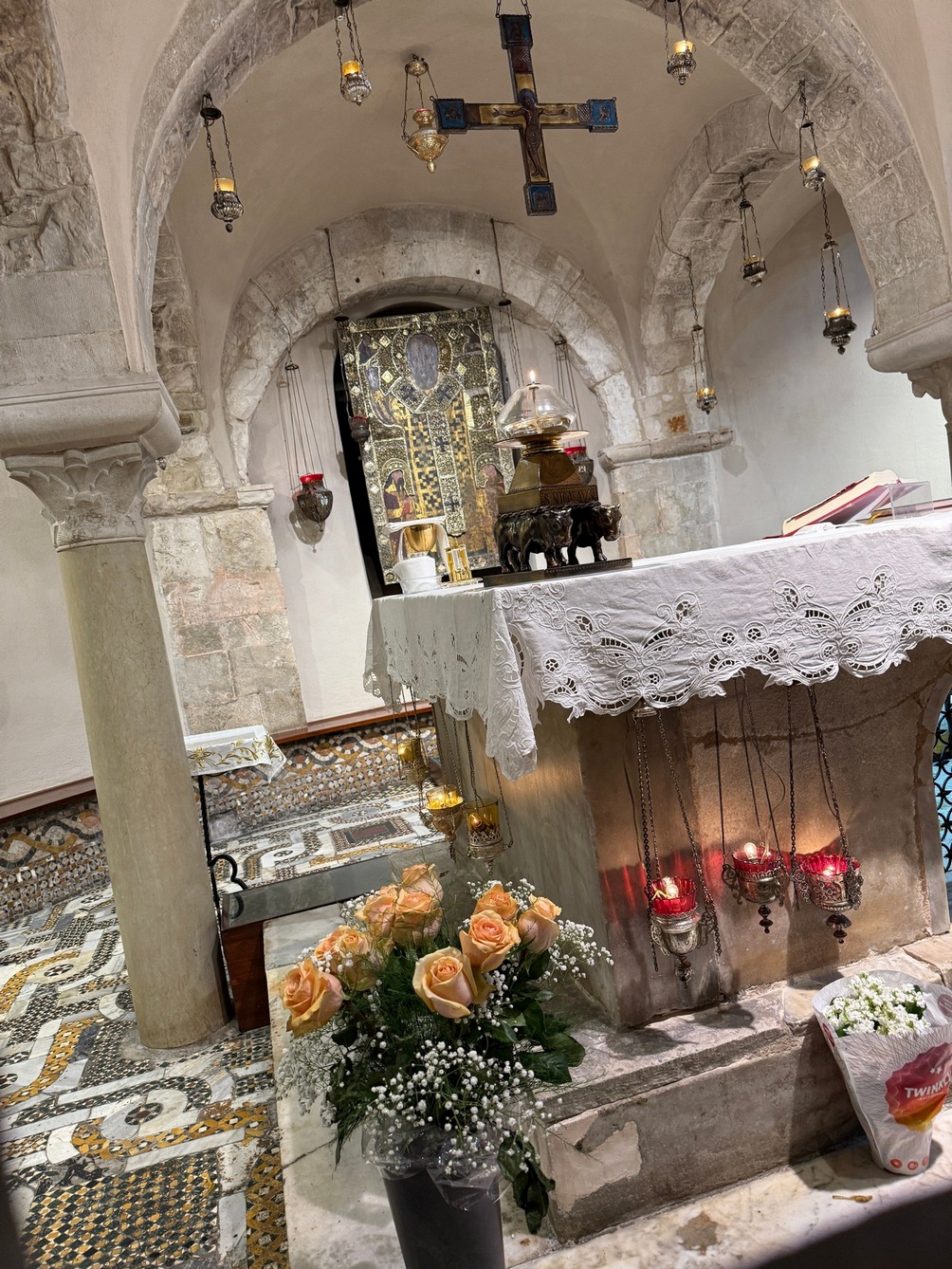
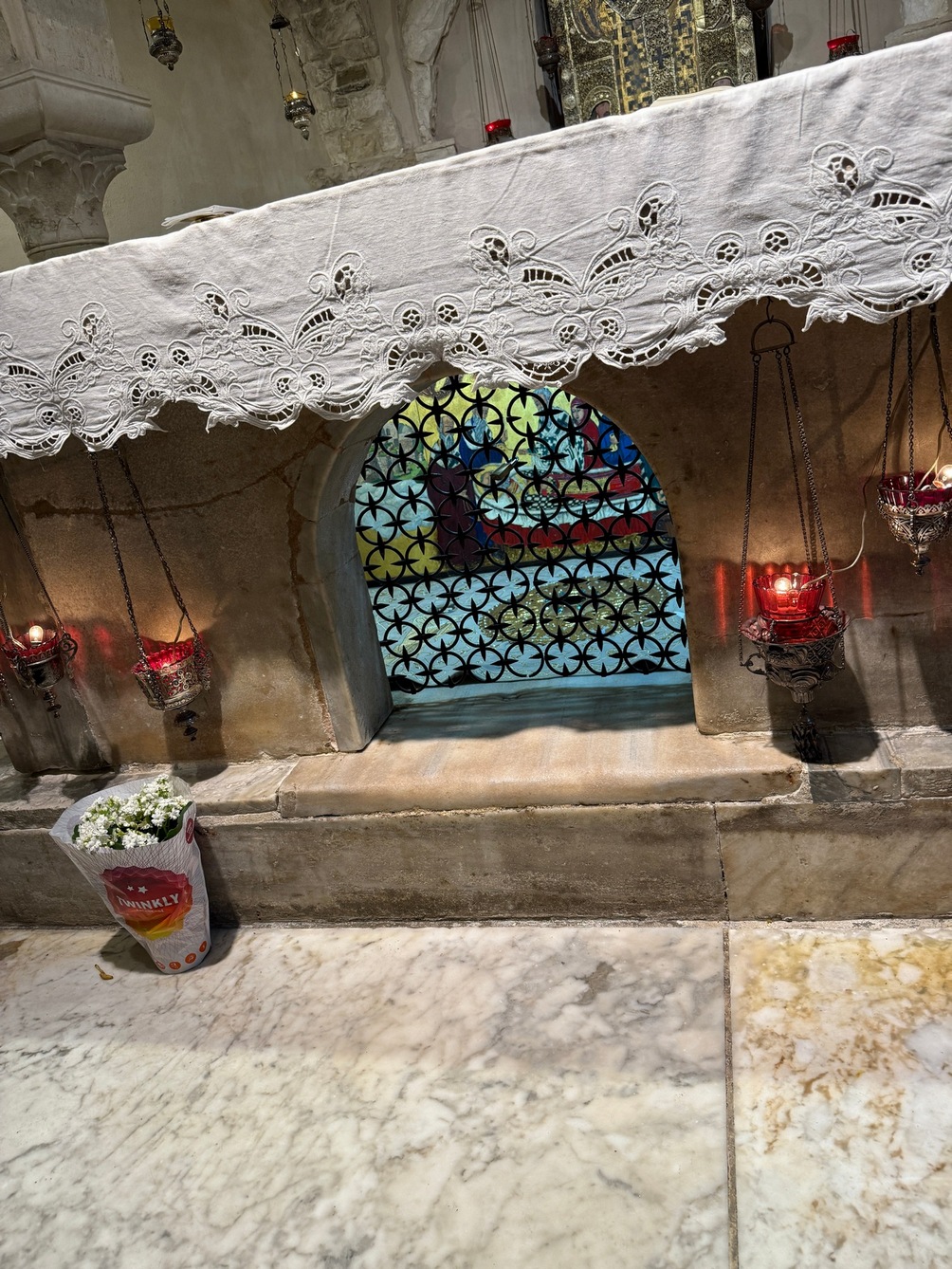
During my visit to the Basilica di San Nicola, I spent most of my time in the underground crypt. The relics of St. Nicholas are kept there behind protective gates. The crypt lies beneath the main church, and its ceiling is supported by marble columns. The saint’s relics rest in a reinforced cement tomb.
Dr. Andreas George believes the stories that some small bones were taken as souvenirs by the sailors from Bari during their expedition. “I do not believe any relics were left behind during their quick departure from Myra,” said Dr. George.
He also doubts the claims that some relics are now in Venice or the Archaeological Museum of Antalya. “I am quite certain that in 1972, a small fragment of the relics was donated by the Catholic Church to the Greek Orthodox Church in New York,” Dr. George explained.
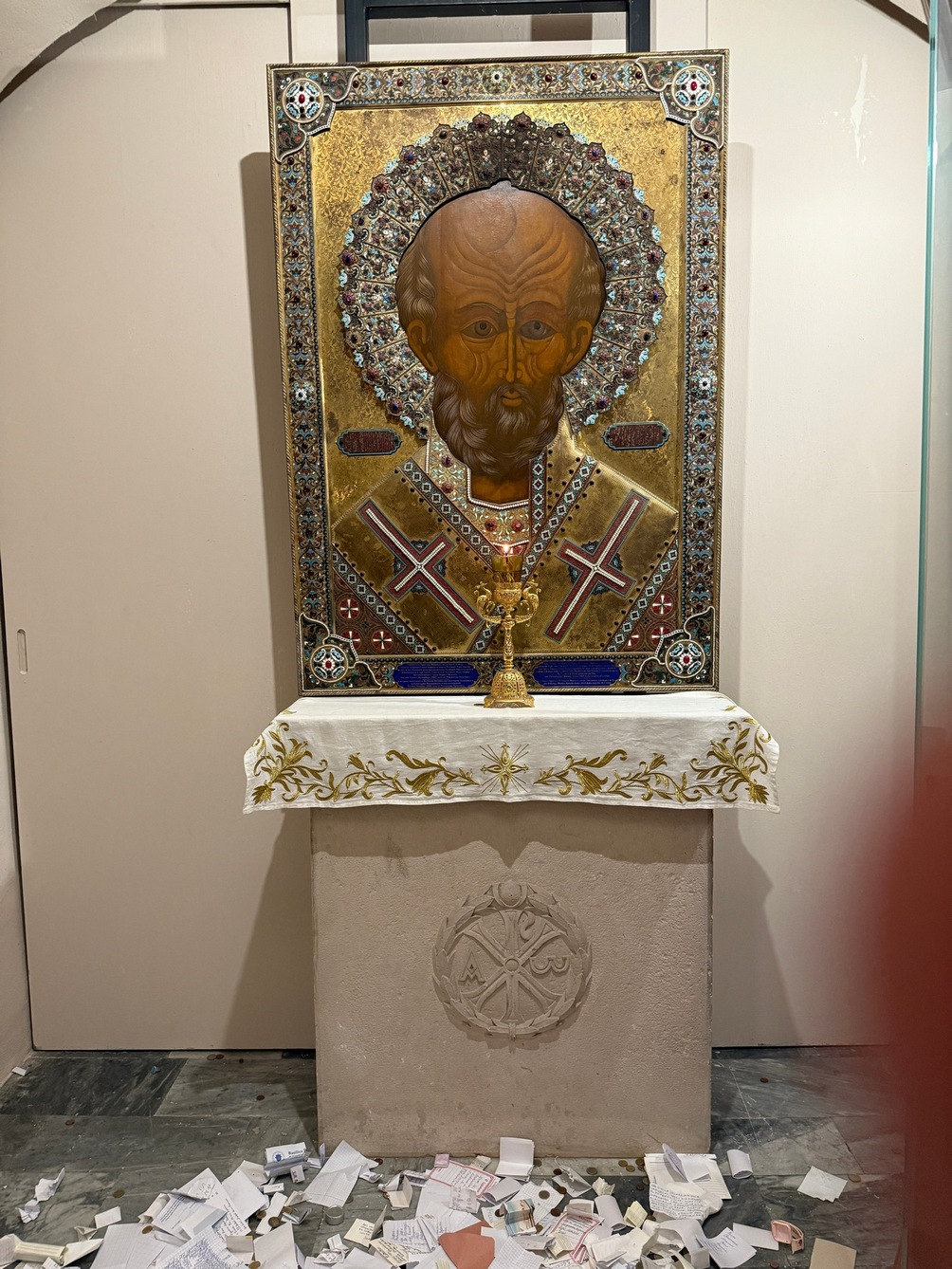
When the basilica was repaired in 1953 and 1957, two doctors studied the bones and reconstructed the physical features of St. Nicholas. Their findings showed that he died at over 70 years old and had facial features like those seen in icons in churches, monasteries, and museums. Professor Martino, one of the examiners, said the bones belonged to a man of Mediterranean origin—most likely a Greek from Asia Minor.
A clear liquid called mana forms in the saint’s tomb each year. On May 9th, the feast day of the transfer of the relics to Bari, about 50 milliliters of this liquid is collected. It is mixed with blessed water and given to worshippers. The source of this pure water inside the tomb remains a mystery. There are different opinions about where it comes from. Dr. George believes that “the use of the mana is a source of hope and healing for those who look to God and his servant St. Nicholas, seeking his intercession and protection.”2
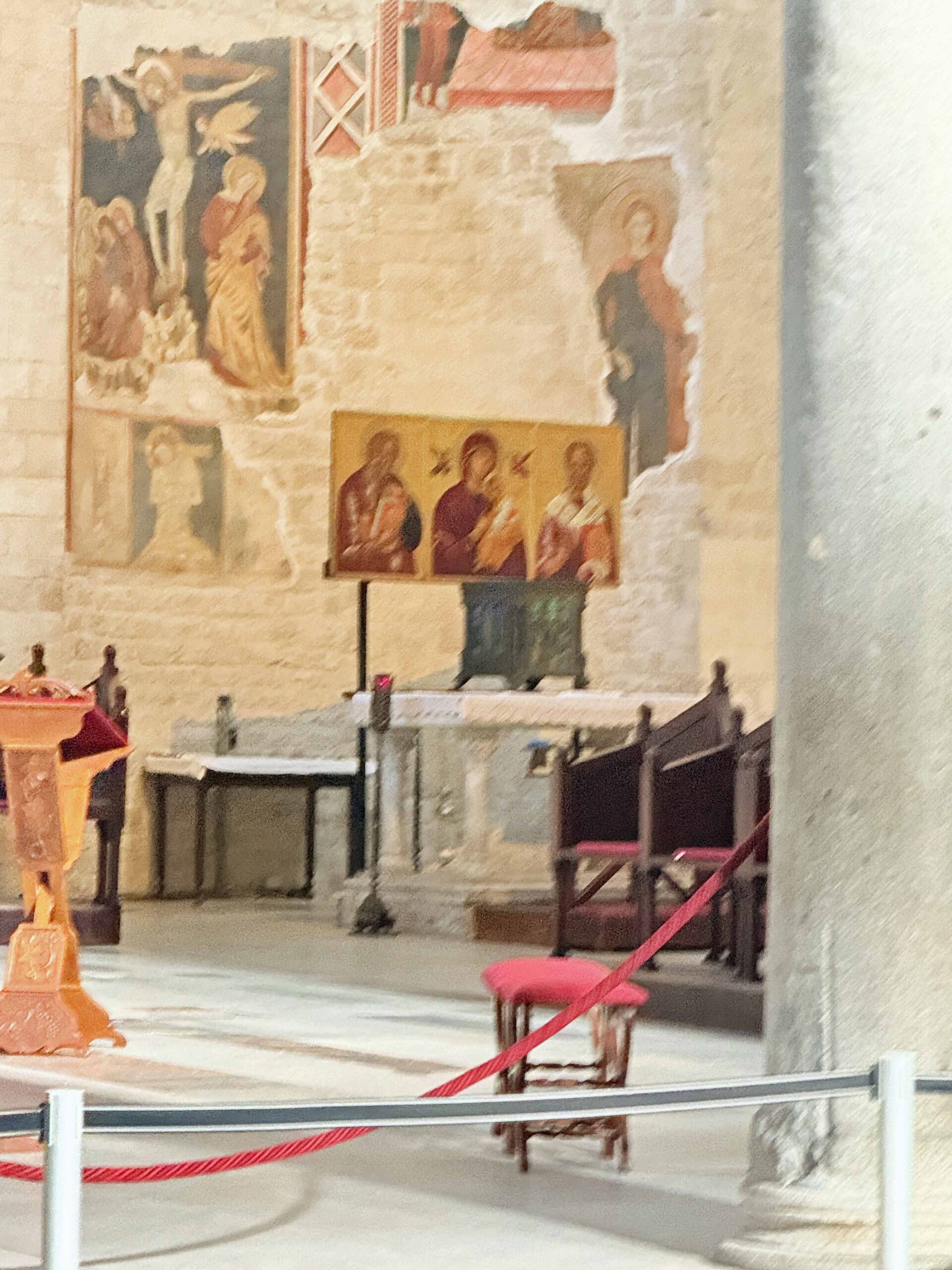
On one side of the crypt is an Eastern Orthodox chapel where Orthodox liturgies are held. The Basilica di San Nicola in Bari stands as a living symbol of unity between Eastern Orthodox and Western Christians, joined in their shared faith in St. Nicholas. He is honored as a powerful miracle worker in the Eastern Orthodox Church, which has about 260 million followers worldwide—from Greece, Serbia, Georgia, Ukraine, and Russia.
I sat at the Orthodox Chapel on the side area of the crypt, meditating..St. Nicholas, a single saint, a bishop from Asia Minor, who lived almost 1,700 years ago, serves today as a bridge between Eastern and Western Christianity.3 Visiting the crypt and Basilica di San Nicola was a destination for the soul. Visiting the Basilica in Apulia where Byzantium is alive, was an experience to remember.
References:
2. Andreas C. George. IN THE FOOTSTEPS OF SAINT NICHLAS,(Seaburn, Astoria NY 2005), pp. 39-40.
3. https://italien.news/en/travel
Links:
https://www.britannica.com/sto
https://around.bari.it/basilic
https://www.summerinitaly.com/
https://www.cnn.com/travel/bar
https://www.britannica.com/bio
https://www.turistinpuglia.it/


 Please wait...