


By Terry Poulos, special to the Hellenic News of America
TRANSCENDENT SOPHIA: When scientists speak of emergence, they mean Nth (not 1st or even 3rd)) order complexity. Example: Lamb is 1st order, a gyro sandwich is Nth order. Recent university research, backed by data from the US Social Security Administration (SSA), has the sophist in me leaning toward Sophia – one of the most popular Greek names – as being a universal, transcendent first principles inevitability opposed to an emergent colloquial human construct. Writ large can mirror the microcosm. The preponderance of circumstantial and empirical evidence may yet point toward a bottom-up, fundamental fractal-like cascade of logic. Exhibit A: Anecdotally, Sophia (alternately, Sofia) rolls smoothly off the tongue, ever so sophly. Can it be mere coincidence Hagia Sophia is one of the most sublime edifices of the ancient and modern worlds? Okay, I got swept up in soph-omoric antics. On to Exhibit B: Last year, Professor Body Winder of the University of Birmingham unwound a study revealing Sofia/Sophia to be the most pleasant-sounding female name, based upon linguistic and phonetic criteria. While one study does not equal 7-sigma proof, enter Exhibit C. Among the top 10 of the SSA list of the most popular female newborn names in the United States for 2025, Sophia lands at #6 and Sofia #10. Combining the two, a logical procedure as both are phonetically annunciated precisely the same (spelling being a distinction without a difference), then Sophia/Sofia rises to the top of the list. Is this natural selection, a type of underlying order? Or should Sophia’s near default preference and ubiquity be chalked up to a random quirk of the evolution of the human cochlear system of audial perception?
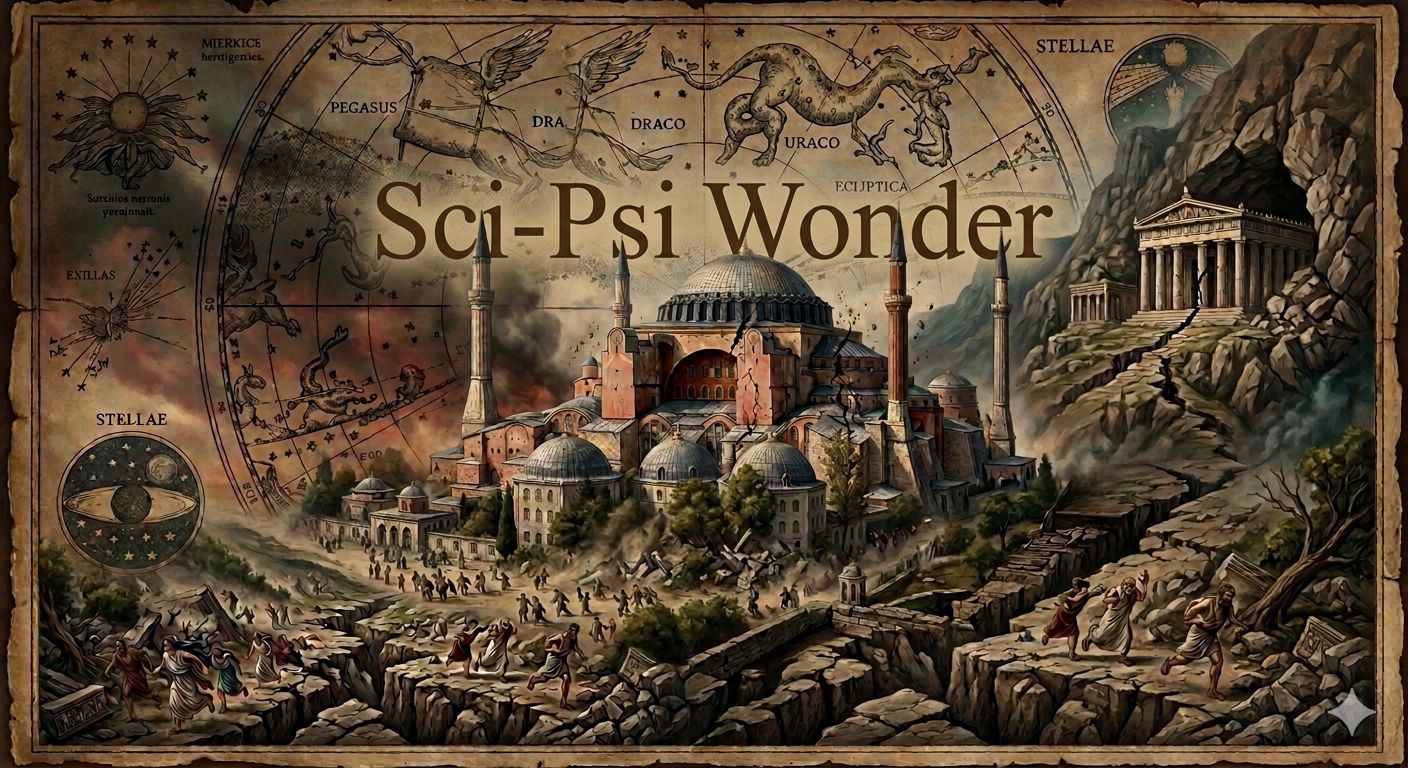
SEISMIC SOPHIA: Hagia Sophia, commissioned by Byzantine emperor Justinian I in 532 CE and finished in 537 CE, may yet be the namesake of a universal scaling law (see prior item), but she herself is not infallible like the God which resides under her majestic dome. It’s estimated that Hagia Sophia has withstood anywhere from a dozen to dozens of earthquakes throughout her 1500-year history, chiefly due to ingenious flexible construction and centuries-in-advance engineering by chief architects Anthemius of Tralles and Isidorus of Miletus, mathematician/geometers and physicists of the highest order. However, they were not geologists, and in any event there were no detectors sensitive enough to even fathom what lurks below the surface. Hagia Sophia’s most grave challenges still lie ahead. A study published in the journal Science in December draws attention to renewed seismic activity in the earth’s crust that “cuts into the Sea of Marmara, just south of Istanbul,” warn researchers. The western segments have been “left unruptured over the past century.” But the data suggests a “pattern of rupture propagation since 2011. The epicenters of ruptures of moment magnitude…including the 2025 6.2 event, have generally migrated from west to east, as have their aftershock sequences, breaching formerly quiet fault segments in what looks like a steady march toward a city of 18 million people.” Otherwise known as Constantinople. Moreover, “the seismically active portion of the fault includes creeping and transitional segments with some of the most recent seismicity located near the presumably locked Prince’ Islands segment south of Istanbul that has potential to generate a (magnitude 7) earthquake.” Nature reclaims all, in her own due time.
PITHY ‘HIGH’ PRIESTESS: Maybe the Oracle could have shed light on Hagia Sophia’s future. The famous Oracle at Delphi, home to an Eleusinian Mysteries cult, was an ancient Greek temple where myth informs us a high priestess possessed the power to divine the future. Truth seekers came from far and wide to seek counsel. In modern times, using chemical analysis of site samples, scholars speculate the priestess – called Pythia – may have literally been high. A 2006 study indicated a possible cocktail of carbon dioxide mixed with methane may have seeped from beneath the rocks, thereby intoxicating inhabitants. In February of 2026, a new study was published showing evidence a fungus (mushroom or hallucinogenic) type of substance may have caused delusions in the oracle’s mind. Regardless of the source of these visions, one does wonder what kept generations of seekers continuing to make the journey to Delphi. Did Pythia, ostensibly offering little in the form of pragmatic pithy platitudes, pay scribes to be social influencers? Maybe they had access to boosted facetime at the public square.
PALIMPSEST REVEALS OLDEST SKY MAP: In recent years, historians have been having a field day using cutting-edge x-ray, photon and quantum imaging techniques to reveal writing and art that was previously scribbled off so that parchment and papyrus (primarily animal skin) could be reused for new purposes. Scientists at Stanford University, reports Science Alert, recently imaged the 6th century Codex Climaci Rescriptus, a religious manuscript discovered at St. Catherine’s Monestery in the Sinai Peninsula of Egypt, coincidentally also commissioned by emperor Justinian I. Beneath a series of prayers in the codex was revealed the oldest map of the night sky ever discovered, a masterstroke crafted by ancient Greek astronomer Hipparchus (c. 190-120 BCE ) long before Galileo Galilei (16th century CE) invented the telescope. The Babylonians and others watched and noted the moon, five known planets visible to the naked eye, and stars long before the Greeks. It was entertainment and religion, a version of ‘satellite TV.’ But it was the Greeks who first found means to accurately record these celestial bodies on a medium that would survive well into the future.
We return with more modern Greeks in science in next months edition.
Terry Poulos is a writer and artist/fractal geometer who synthesizes theoretical physics, esoteric number theory, archaeology, and ancient and modern technology. More on his art, science, musings at Scientiquity.com and Scient



 Please wait...