

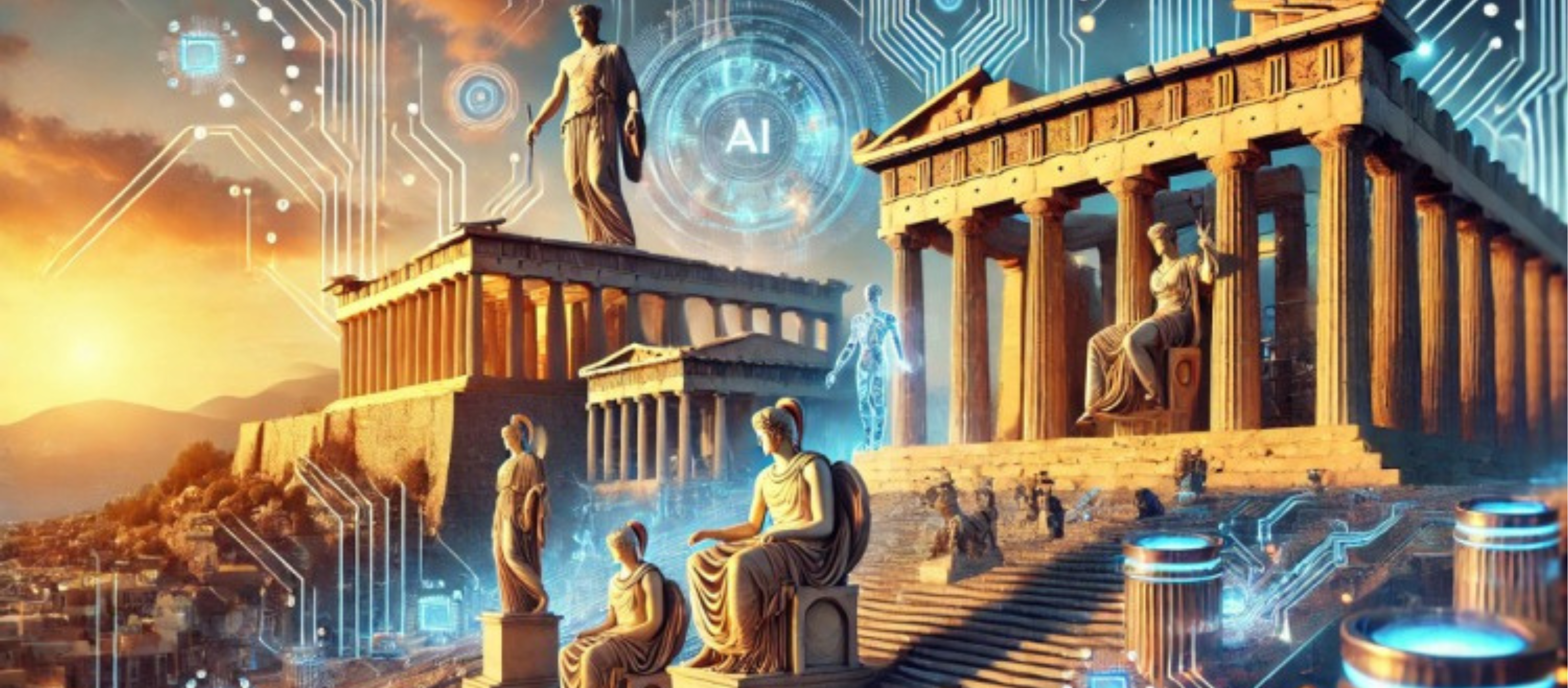

“Wonder is the beginning of wisdom.” These famous words of Socrates capture the essence of the Socratic dialogues, where questioning and wondering are deemed the ultimate path to unlocking knowledge and clarity. However, as emerging AI applications provide instant
answers, where does our wonder—and our wisdom—go?
In modern society, a simple voice or written command to ChatGPT or Siri is enough to satisfy our curiosity, as we have grown accustomed to passively accepting “truths” about the world around us. The vibrant debates of ancient philosophers have given way to a virtual realm dominated by algorithms and interfaces, and as we rush toward a future of instant knowledge, we must ask: Is AI enhancing our ability to think, or have we become all too unsuspecting of the easy answers?
Greece is making significant strides in AI innovation, positioning itself as one of the seven
nations selected to establish and operate one of the first AI factories in Europe, funded by the European Commission under a joint initiative worth a total of 1.5 billion euros. While
historically lagging behind in digital transformation compared to other nations, Greece aims to catch up through government-backed initiatives like the National Digital Strategy, which seeks to integrate AI into education, healthcare, and public administration—in practically every aspect of daily life. PM Kyriakos Mitsotakis has emphasized that “AI is a unique tool that must now be integrated into public policies,” noting its potential to simplify life in our cities.
As promises of rapid innovation and modernization attract global attention and support, profound ethical dilemmas remain—especially for a nation whose identity is so deeply rooted in intellectual inquiry. The risk, however, isn’t just in privacy breaches or algorithmic biases; it’s in the subtle ways AI could shape how we think—or ultimately stop us from thinking at all.
“The real challenge isn’t that AI can’t provide answers, but that we must decide to question
them. Tools like ChatGPT can offer facts, but they fail to capture the deeper complexities of
life—those moments of doubt, moral struggle, and emotional depth,” states Alkis Gounaris, a professor of philosophy at the National and Kapodistrian University of Athens. “When humans defer entirely to algorithms, the rich tapestry of human thought—characterized by doubt, curiosity, and reflection—begins to unravel. We lose the capacity to ask the ‘why’ behind the ‘what.’”
The passive use of AI threatens to dilute the intellectual foundations that have defined Greek culture for millennia. However, ChatGPT and similar tools can enrich understanding when used correctly, much like the Socratic dialogues led to clarity and revelation.
–
In education, for instance, the Greek government aims to integrate AI into classrooms through the AI4edu program: a system that provides tailored support to learning for both teachers and students through the interactive adaptive assistant, Study Buddy. Engaging with students in natural language, the Study Buddy assistant could simulate Socratic-style dialogues, engaging students in thought-provoking debates and challenging their perspectives. Instead of providing definitive “truths,” AI systems could encourage learners to explore different viewpoints, dig deeper, and question their assumptions.
“When used thoughtfully, AI can augment human intellect, providing new insights and tools to enhance critical thinking,” Gounaris adds.
As Greece celebrates its emerging role as a hub for AI infrastructure and innovation, the question is whether we will embrace it as a tool to call on a legacy of critical thinking or allow it to diminish the spirit of inquiry that has shaped our history. As Socrates famously taught, wisdom begins with a question. Perhaps then, in an age where answers are instant, the most profound question we can ask is how to keep asking.

 Please wait...