

by Mino Vlachos
Being CEO is hard. It’s one of the loneliest positions in any organization. The Board is your boss, your team are your subordinates, and you have no peers. You are the face of the organization — both internally and externally. And when things get tough, there’s nowhere to turn.
Where does a CEO go for support?
Beyond their role limitations, most CEOs struggle to even ask for help. They believe they must remain strong at all times, never letting their guard down. This belief that “I must go at it alone” is reinforced daily.
The result? The leader thinks that they become an island — taking on all the stress, all the burdens, with no opportunity for release.
This hyper-independence usually has roots in the past. One Board member I am currently coaching shared with me: “I am focused on becoming a better leader and it’s a lot of looking at yourself, which kind of surprised me. You need to know who you are and how you’re going to interface with different contexts and be able to face crisis. There are predictable patterns that emerge, that come back to things that are hard for you on a personal level… they show up at work.”
Our reluctance to receive support often begins early in life, long before we even take notice. Children love their parents unconditionally and with fierce loyalty. In an effort to help, they take on the struggles of the family — unconsciously carrying emotional burdens that are not theirs to bear.
Many of the leaders I work with still do this… carry the burdens of their families instead of feeling free to write their own story.
When we reflect on our ancestors’ lives, we see joy and hardship, celebration and struggle. The question becomes: what did they intend to pass on to their children, grandchildren, great-grandchildren? Do we pass down pain? Or do we strive to build a life that’s better for each generation?
This multi-generational project — this effort to grow and evolve — is deeply human. To continue it, we must allow ourselves to receive our richest inheritance. To accept the unconditional love of those who came before us, and then, pass it forward ourselves.
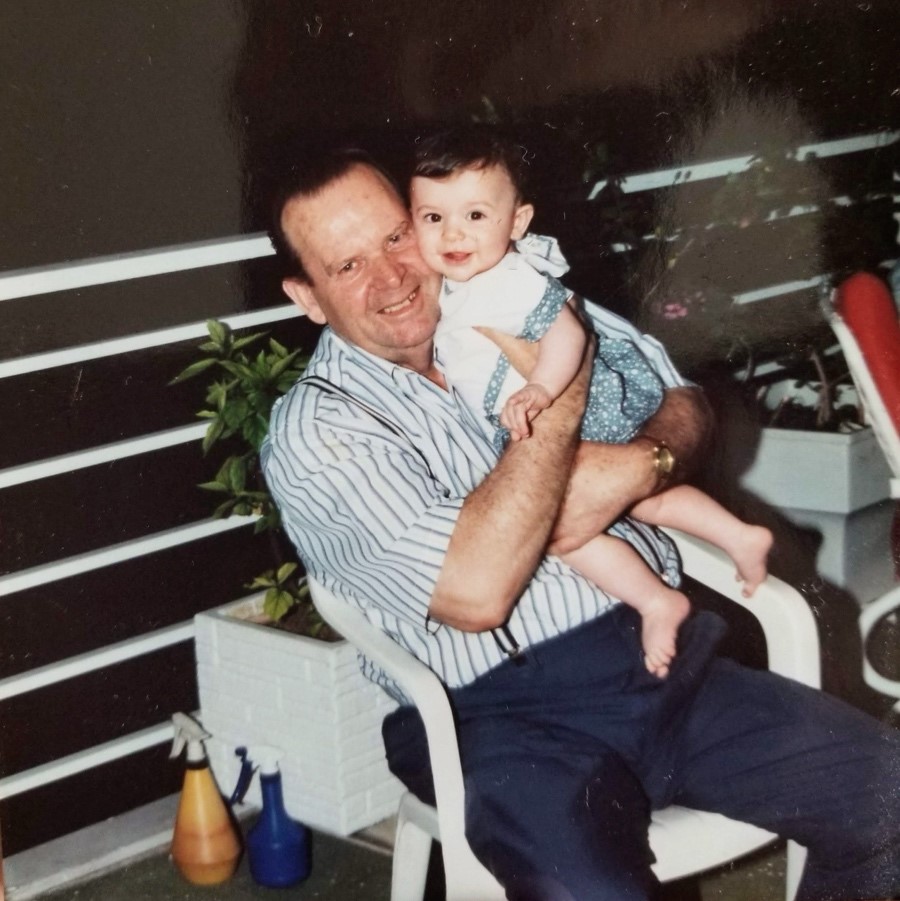
I see this most clearly when I think of my own παππού. As a child, we would ride the trolleys of Athens, chat with the local periptera, and feed the birds at the Zappeio.
Each year, he would gift me something wildly different: once a fishing rod, another time a telescope… a photo camera, a chemistry set, a chocolate making kit.
He taught me to ride my bicycle, lifting me from the harsh concrete after every fall. Safe in his arms I dared try again and again. When I was learning to swim, I was deathly afraid of the diving board. So he would wave an Ion chocolate bar as reward and encourage me to jump into life’s possibilities.
My παππού was an alchemist, for in his hands ordinary objects became sacred, and a single chocolate bar made me feel like the richest kid on the planet. With him behind me, I was an explorer, an artist, a scientist… A child in love with the mystery of existence. That is the power of love.
He wanted me to try things, to discover what I loved. He supported my curiosity and creativity without any pressure. He made it clear: there was love and support, no matter who I was or what I chose.
His support gives me tremendous strength in the here-and-now. Even though he is no longer with us physically, I often feel my παππού’s hands on my back, encouraging me to take the leap of faith and get back up after each fall.
Of course, our relationships with some ancestors may be more complicated. We may feel guilt or loyalty that leads us to carry their burdens. But this is not the inheritance they intended. We need not be Atlas holding the earth on our shoulders. Our task is to let go of what isn’t ours to carry — and to instead accept the love they wanted us to feel.
When we open ourselves to the loving support of our ancestors, we also open ourselves to support in the here-and-now. We can let others in.
It is okay to receive support. After all, no one is an island. Independence is the illusion that cuts us off from life, love, energy, and growth.
When in doubt, reach out. In times of crisis, find a safe harbor, a place to rest and restore.
The leaders who do this — who choose to be open — are the most resilient. And ultimately, the most successful. They surround themselves with people. People who let them simply be, even for just a moment, without needing to be strong.
Sometimes, the greatest act of leadership is learning how to receive.
—
Mino Vlachos is a CEO Coach and the Founder of 3Peak Coaching & Solutions, a leadership consultancy dedicated to elevating executive mastery. 3Peak specializes in transforming businesses through leadership and team development during transitions and times of crisis. Mino is also the host of the 3Peak Master Leadership Experience podcast and the author of the book “Crisis & Leadership”.
https://www.linkedin.com/in/minovlachos/

 Please wait...