

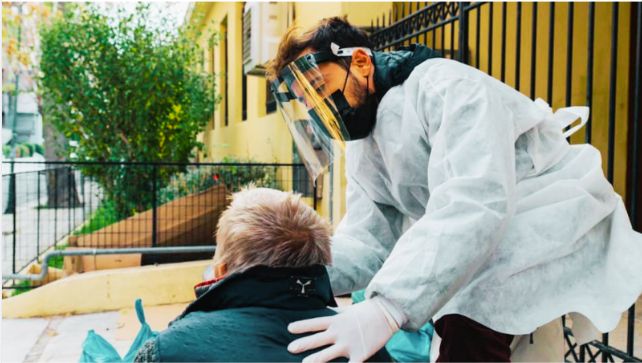

“They died like sheep, through having caught the infection in nursing each other.”— Thucydides, History of the Peloponnesian War (Book 2, Chapter 51)
Thucydides records that Plague struck Athens in 426 BC, the second year of the Peloponnesian War. Within his writings, we see the chaos spreading in the city, the anarchy, the families perishing, the pain, sorrow and the hardship brought upon society. Yet the records we forget, the ones of the sick being tended in the streets, the abandoned corpses buried by strangers, are the ones that present what the Greeks stood for: a “koinonia”. A society built upon fellowship, cooperation and virtue. The principles that define our communities today.
Since the antiquity period, our nation has been no stranger to crisis and hardship. In just the last 20 years, Greece has lived through a staunch debt crisis, an ongoing refugee issue, a global pandemic, ravaging wildfires, earthquakes and dozens of other social crises that alone could corrode the foundation of a community. Yet, time and again –whether in the ancient agorae or in modern city squares– the instinct has remained the same: to turn inward to community, and outward in compassion. And by going back, merely in the last decade, we can remind ourselves of the enduring principles that define our connection.
We look back 10 years, amidst the austerity crisis of the 2010s, and remember the families queuing outside the banks, the homeless pouring in the streets, the unemployment peaking at 28%. Yet even then, in the depths of hardship, something older than the crisis itself endured: the ancient principle that the good of one is bound to the good of all. We saw it in the assemblies across Athens, Thessaloniki and Patras, where neighbors gathered to feed hundreds each day and provided shelter for those in need. We saw it in businesses like Venetis, which famously gave away ⅓ of their production to the hungry. And we saw it in the small, quiet acts: a blanket given to a family sleeping on the park bench, a bowl of “Tragana” shared to a man beneath a streetlight. In those moments, the Aristotelian principle of koinon sympheron, the common good, wasn’t just a distant philosophy, but rather a lived truth.
We watched the refugee crisis unfolding on the islands of Lesbos and Chios, where islanders became living testaments to “philoxenia” –the sacred form of hospitality Homer sang of in his epics. We saw islanders pull migrants out of perilous seas, yiayiades offer children bread, hotels transform into sanctuaries of warmth for the unfortunate and evidently a Nobel Peace Prize nomination for the “heroes of the Mediterranean”. This compassion was no anomaly. It was, and remains, a reminder of an essential Hellenic value: that no soul should cross a Greek threshold unwelcomed.
Even when the silent threat of the pandemic emerged in 2020, and the world isolated itself behind shuttered doors, our koinonia still persisted. It was not long before balcony serenades filled empty streets, neighbors exchanged trays of spanakopita, and applause for doctors echoed from window to window. Even in isolation, fellowship endured.
When wildfires scorched the hills of Evia in 2021 or when a blaze burnt the mountains of Attica in 2025, we observed ancient “arete” surge through modern veins. On the slopes, tens of thousands of volunteers stood alongside firefighters, defending our homes and forests, standing for what is just, noble and necessary in the face of destruction. Every year then, in the burning terrains of the nation, it is the ordinary Greeks who become the guardians of their land, proving that the ancient pursuit of arete lives not in words, but in action.
And perhaps that is Greece’s greatest legacy; not the marble ruins, nor the storied names of philosophers and heroes, but this unyielding commitment to one another. In a world where crisis too often fractures, the Greeks remember. We remember that we do not merely descend from history, but actively carry it forward: to live with arete, to open doors with philoxenia and to rise, always, through synergasia.
By Nikolas Giannopoulos, Student Writer (Intern at Hellenic News of America)

 Please wait...