


By Catherine Tsounis
“For a good man to leave his city, his rich fields and go a begging is of all things most miserable. Wandering with mother dear and aged father with little children and wedded wife. For hateful shall such an one be among. All those to whom he be among. All those to whom he shall come in bondage, to want loathsome penury, (poverty), and doth shame for his lineage and belie his noble beauty, followed by all evil and dishonor.” Ancient Greek poet Trytaeus.1
September 2025 marks the 103rd Anniversary of the Annihilation of the Greek cities of Asia Minor and population exchange of the remaining Greeks. Poet Trytaeus quote describes their struggle in modern Greece as refugees. This memory is handed down to the Greek families of 2025.
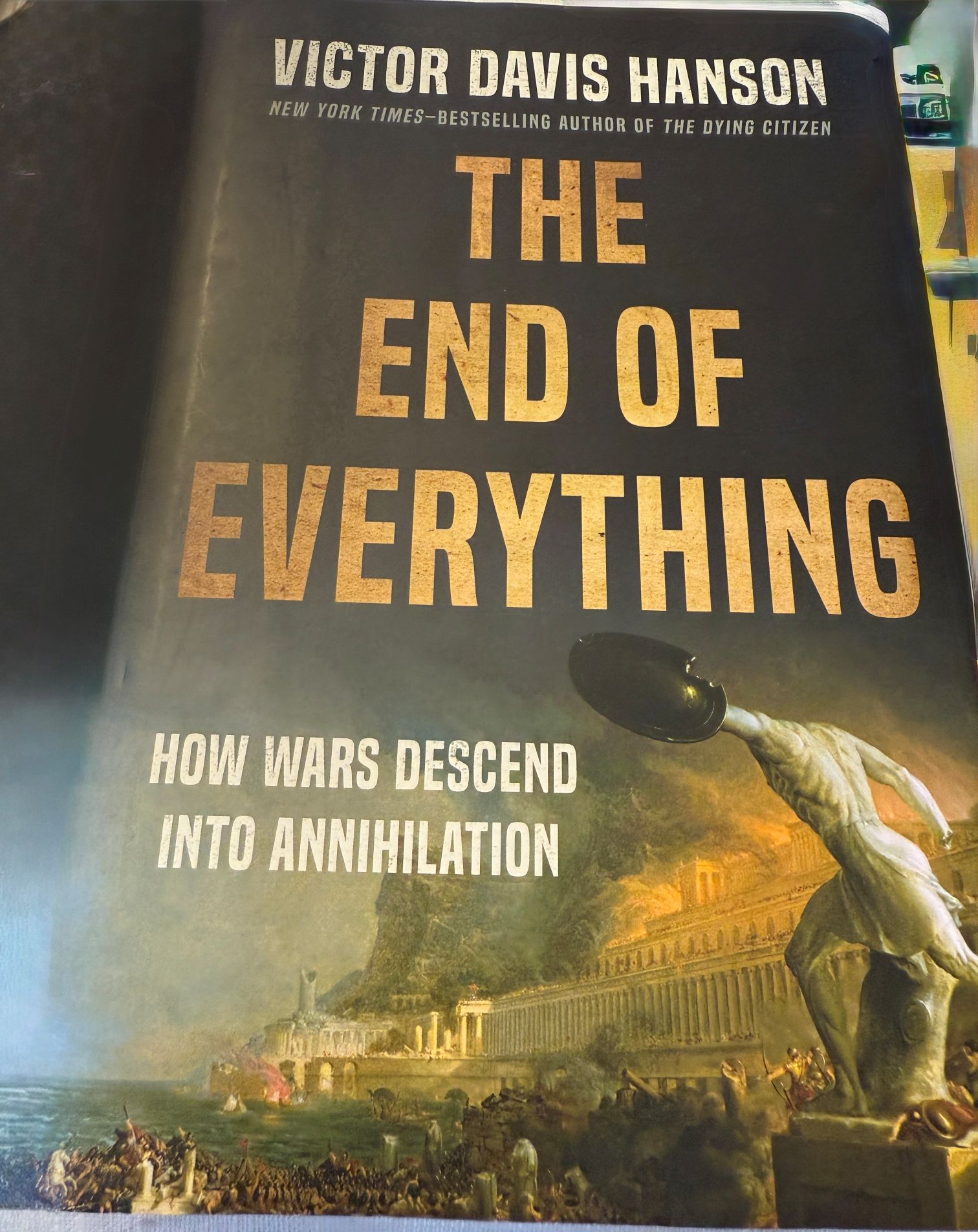
We all know the Greek viewpoint. How is the Asia Minor catastrophe viewed by an American scholar? Victor Davis Hansen is an American classicist, military historian, and conservative political commentator. He spent two years learning Greek in Athens, living in an Asia Minor community. In his latest book THE END OF EVERYTHING: HOW WARS DESCEND INTO ANNIHILATION, he accurately describes the truth.
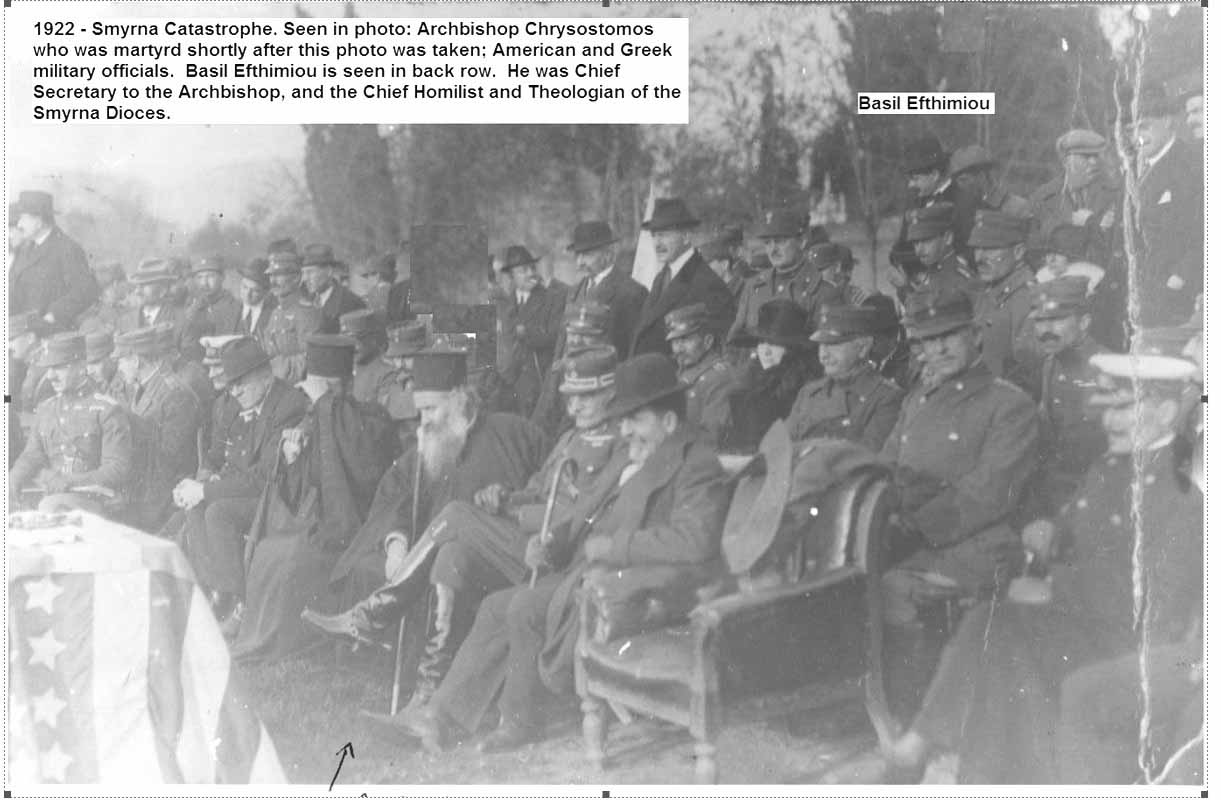
“The idea of a living Byzantium re-emerged, only once as a fantasy.,” said Hanson. “The Hellenic dream of a “Megali Idea” or Great Idea emerged upon the dissolution of the Ottoman Empire A 20th century Pan Hellenic Aegean was seen as uniting Greek speakers of Asia Minor, the Greek mainland, the islands and the northern Egyptian coast. It was crushed by Turkish nationalist Mustafa Kemal Ataturk’s army destroyed Smyrna in 1922.”2 The Late Milton Efthimiou emailed a photo of the last public appearance of the Metropolitan Chrysostomos of Smyrna with the Allies and his Father Rev. Basil Efthimiou, before he was given to angry Turkish crowds in a barbaric killing.
Hanson reveals the latest studies of the DNA of the Turkish people, that is not accepted in the Greek or Turkish viewpoint “Yet in a strange twist of demographics, a recent DNA survey of the current Turkish population allegedly revealed that the majority has predominantly Anatolian Greek ancestry, rather than a genetic inheritance from the arriving Turkish tribes that eventually aggregated into the Ottomans. The study has evolved outrage, and the contemporary Turkish government, given its efforts to account for current Turkish antipathy towards modern Greece in the Ottoman notion that historically, and presently Hellenism had no legitimate claim in either the eastern Aegean or Anatolia. Nonetheless, if accurate, DNA studies suggest that while the Byzantine empire receded before and was absorbed by the Seljuk Turks, millions of the ensuring conquered indigenous populations remained ethnically Greek, and eventually became culturally indistinguishable from the later Ottomans”3
The scholar continues saying “in the mid and late 19th century, in the waning decades of the enfeebled Ottoman Empire, there was a resurgent Greek presence in Anatolia. Opportunistic reverse Greek migration into the more developed central coast of Asia Minor had been encourage by the start of the Greek revolution against Ottoman rule in 1821, and the subsequent relaxed immigration laws of the fading Ottoman empire. The result was that Greek immigrants began swelling the existing remnant population of the ancestral Greek minority communities on the coast of Asia Minor. By the early 20th century, Greeks may have again formed a near majority of the population of the historical Greek city Smyrna renamed the current Izmir in 1930.
The Greek speaking population of the new Turkish state rebounded to over 1 million among the central coastal Ionian cities and the Black Sea coast.
After the defeat of the Central Powers and their ally Turkey in World War I, the Greeks were energized by having an ally in Britain and France. Once the fight began between Greece and Turkey, their allies, England and France abandoned the Hellenic cause, leading to its tragic defeat. The burning of Smyrna led to the final defeat, with a Greco-Turkish war settlement giving up acquired territories and historic claims to Constantinople. Population exchanges soon followed with over 1 million Greeks fleeing Turkey to Greece. By 1930 there was no real cohesive Greek community left in Asia…So ended the entire Megali Idea an three millenia (3,000 years) of Greek civilizationin Asia Minor-the final footnote to the end o Byzantium.”4
Hanson sees a recurring universally human theme across time and space occurred. The doomed, at the brink of civilization destruction, have an attitude, partly born of hubris and partly of naivete, perhaps best summed up as” it cannot happen to us.”5
How is this important in 2025 Greek-Turkish affairs? Scholar Hanson says. “there are other nations and people that have a long and sad past of vulnerability and persecution, for whom a major war of escalation could threaten their very existence . These people reside in dangerous neighborhoods and have relatively small populations with limited resources, but long histories. A good example is Orthodox Greece of little more than 10 million people occupying some 51,000 thousand square miles of strategic real estate, with a population density of only 200 persons per square mile and without much natural wealth. It faces a hostile fellow NATO member, its historical conqueror and occupier – Turkey. The latter has increasingly shed the pro-western, secular traditions of its founder Mustafa Kemal Ataturk
and under its Islamic leader Recep Tayyip Erdogan instead redefined itself as the rightful heir of the Islamic and expansionary Ottoman empire that absorbed the Greek Byzantine Empire. The Turkish government has openly praised its Ottoman imperial heritage while downplaying. It’s founder’s secular vision.
Turkey insists, that it’s former occupation of Greek speaking northern Cyprus, and the current puppet state of the Turkish Republic of northern Cyprus (recognized only by Turkey) are permanent realities. Turkish President Erdogan has repeatedly vowed to invalidate by force, if necessary, legitimate natural gas, and oil claims by force necessary of Greece and Cyprus in the Eastern Mediterranean. Increasingly Turkey does not recognize the Greek sovereignty of the major Greek islands off the coast of Asia Minor and considers their status fluid and eventually Turkish.
As a result, in the Aegean, Turkey, each month conducts dozens of provocative overflights of Greek territory, while insisting the islands remain demilitarized to avoid a Turkish invasion. Meanwhile, NATO member Turkey has grown closer to China, Iran, and Russia, while stepping up its anti- US and anti-European rhetoric.”6
Dimitri Filippidis, international Greek American journalist/HellasFM Radio Anchor, described “Turkey’s claim of the Aegean islands that includes Limnos, Lesvos, Chios, Andros and others in his September 15th program. Turkey and Greece are at odds over the jurisdiction of the Aegean Sea. Turkey’s sonographic vessel Piri Reis
conducted scientific surveys stretching west of Lesvos, south of Chios and the islet of Kalogeras located between Chios and Andros,”
For more Information, contact Dimitris Filippidis on Facebook
The enmity continues 103 years after the Asia Minor Catastrophe.
THE END OF EVERYTHING: HOW WARS DESCEND INTO ANNIHILATION by Victor Davis Hanson is an excellent analysis of the past and present. It is available on Amazon.
References:
1. https://www.qgazette.com/
2. Hanson, Victor Davis. THE END OF EVERYTHING: HOW WARS DESCEND INTO ANNIHILATION (New York: Basic Books, 2024),p.9.
3. Hanson, p.188.
4. Hanson, pp.189-190
5. Hanson, p, 257.
6. Hanson 283-284.
Links:
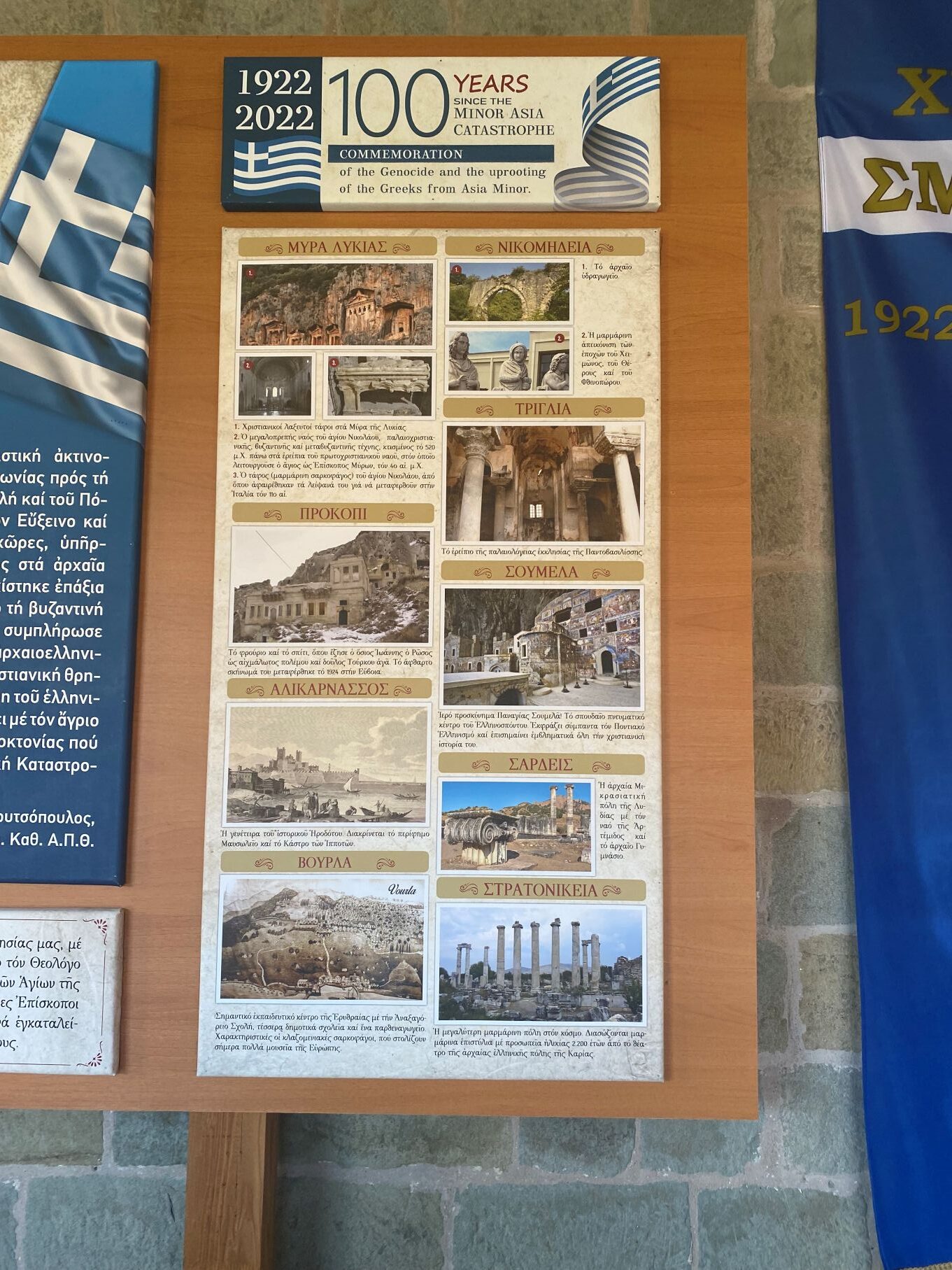
The 100thAnniversary of Asia Minor Catastrophe: Treasures of the Izmir Museum

 Please wait...