


By Catherine Tsounis
We take freedom for granted. No one realizes in 2026 what it means to be a second class citizen. “A generation which ignores history has no past — and no future.” — Robert Heinlein (American writer).
Four hundred years of slavery and racism had made many Greeks bow their heads, when they saw a Turk, enduring his authoritarianism fatalistically. After all, those who had stood up against the tyrant often paid with their heads.” A theme Greek songs and programs is that “Greeks do not bow their heads,”
In the Ottoman Empire, in accordance with the Muslim dhimmi system, Greek Christians were guaranteed limited freedoms (such as the right to worship), but were treated as second-class citizens. Christians and Jews were not considered equals to Muslims: testimony against Muslims by Christians and Jews was inadmissible in courts of law. They were forbidden to carry weapons or ride atop horses, their houses could not overlook those of Muslims, and their religious practices would have to defer to those of Muslims, in addition to various other legal limitations.[2] Violation of these statutes could result in punishments ranging from the levying of fines to execution.1
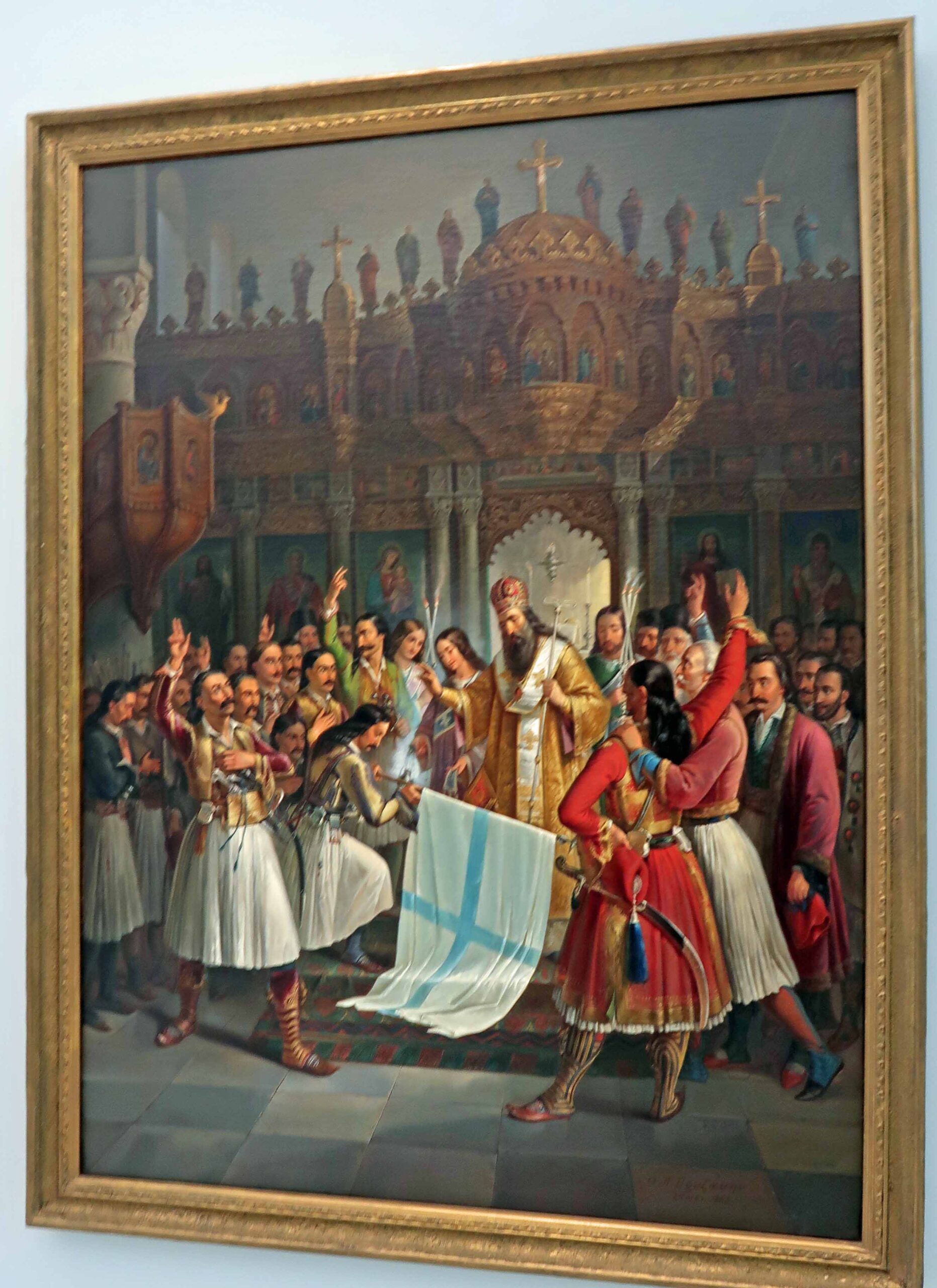
Theodoros Vryzakis, “The Painter of the Greek Revolution” painted the day the Greek Revolution began with painting “The Bishop of Old Patras Germanos Blesses The Flag of Revolution,” on March 25th, 1821, at Agia Lavra monastery, Peloponnese. This is the major holiday of the Anunciation of the Virgin Mary, giving a religious significance of the uprising. The phrase “Liberty or Death.” resonated that day.
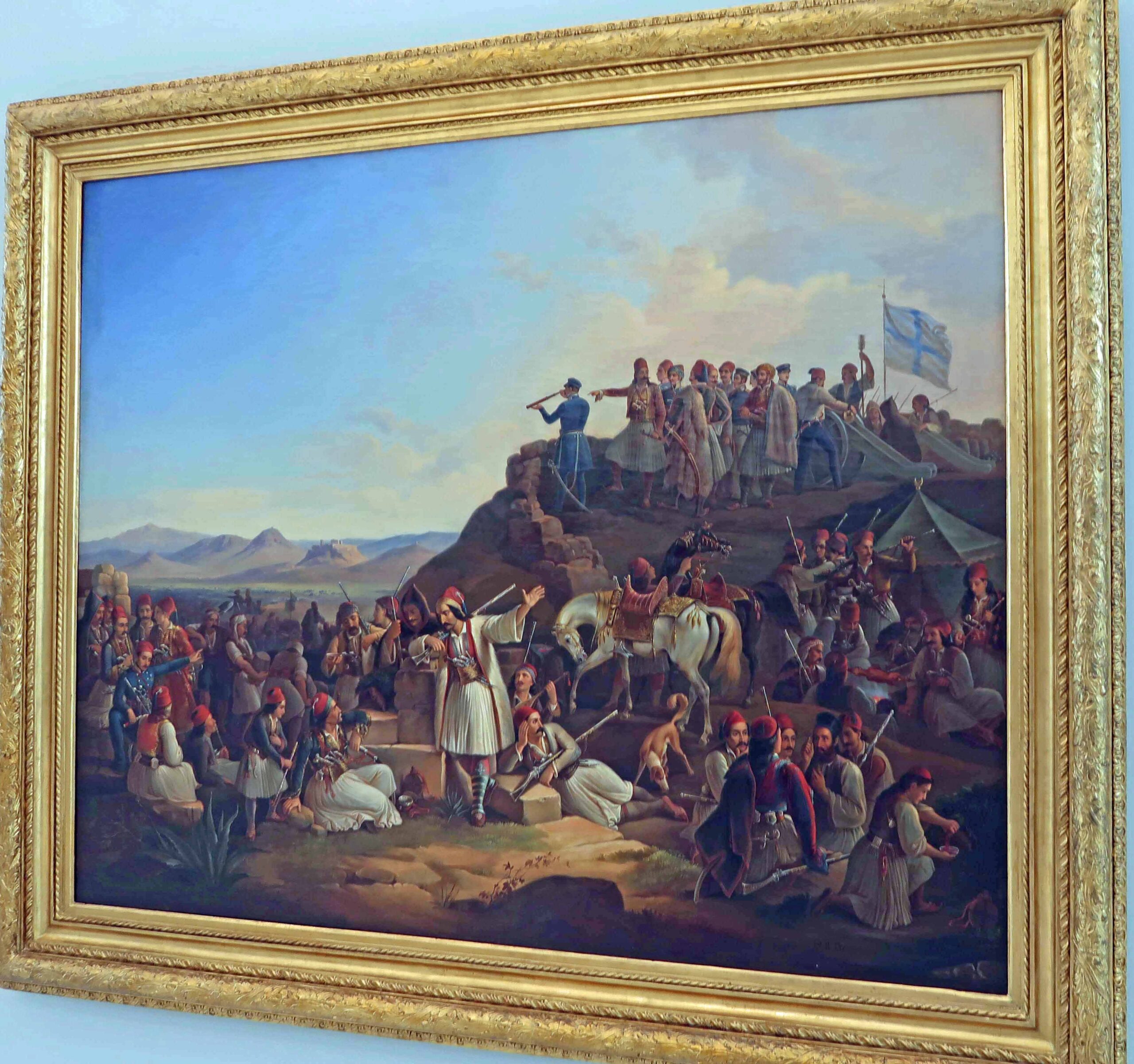
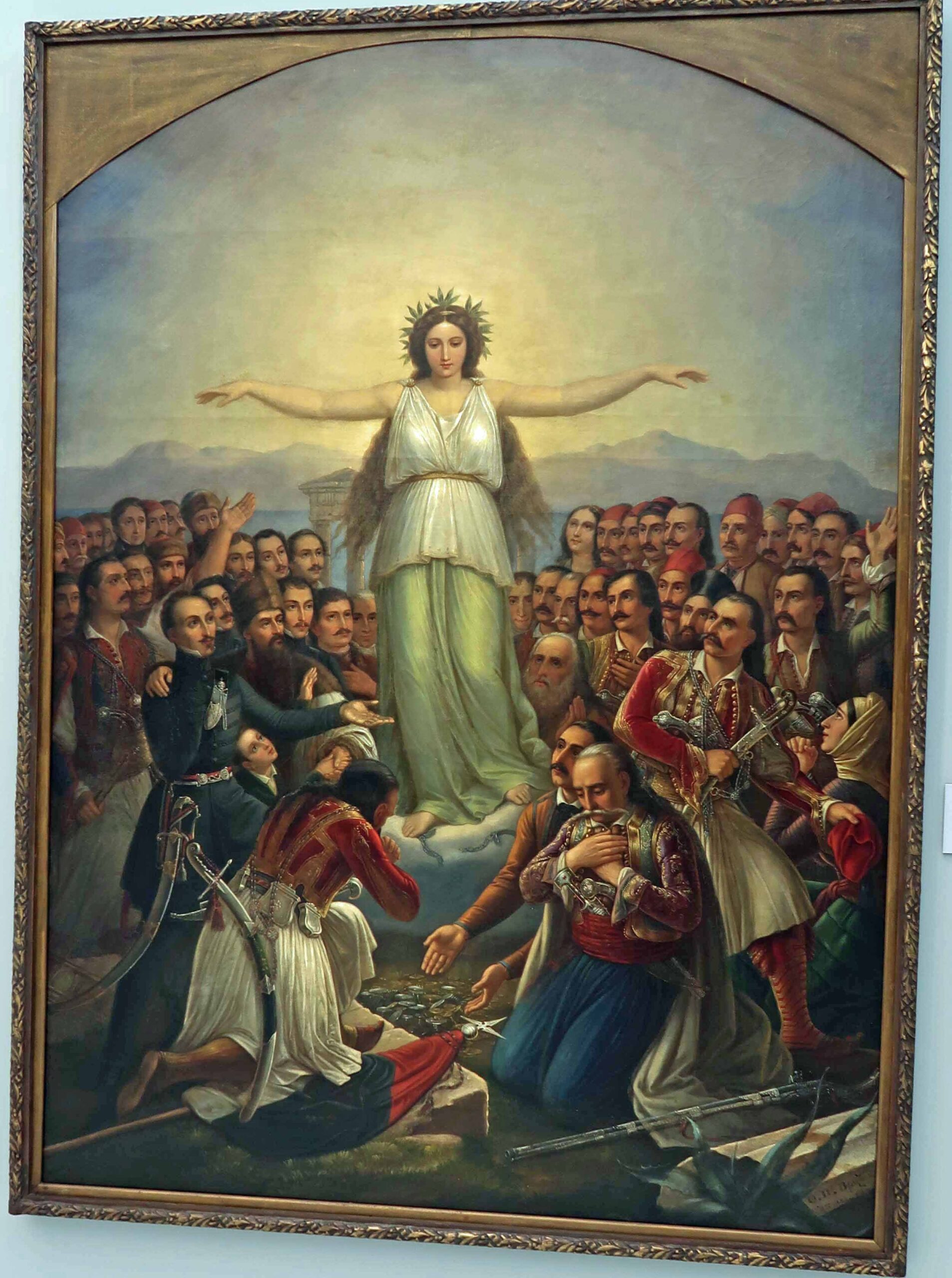
Vryzakis received silver medal 2nd class at the 1870 Olympia for his lithograph “Karaiskakis’ Army Camp”). A person gets an insight into a Greek war camp. “The Defense of the Homeland Above All Else,” shows a beautiful Ancient Greek woman with a crown of glory spreading her arms around major fighters kneeling around her. They include poets, princes, diplomats and generals such as Rigas Feraios, Adamantios Korais, Alexander Ypsilantis, Theodoros Kolokotronis, Michael Soutzos, Governor Kapodistrias,
Georgios Karaiskakis, Odysseas Androutsos, Kostantinos Kanaris, Andreas Miaoulis and Laskarina Bouboulina.
The Greek Orthodox Church, merchant class that created the revolutionary organization of the Filiki Eteria, Alexander and Demetrios Ypsilantis brothers inspired the successful outbreak of Greek Independence in 1821. Fortunes were lost. Genocide of Christian population by invading Ottomans was experienced. The outcome: Independence.
Lars Brownworth, a former high school history teacher, is the creator of the podcast phenomenon “12 Byzantine Rulers” that iTunes named as one of the podcasts that define the genre. In an interview with The Greek Current, author Brownworth answered the question “Why is Byzantine Empire largely neglected and ignored in High School and College History Departments? The Byzantine Empire is a loser in History. I say it loving it. There is not a political successor to the Byzantine Empire, The lands it controlled, the heartland, Middle East, Turkey is Muslim. They do not look back to the Byzantine Empire for culture or religion. The current inhabitants of Byzantine lands do not look to the Byzantine Empire for culture and religious heritage, except for Greece. The West ignores it too.” 3 Excellent point few acknowledge.
What is the DNA of the modern Turk? June 25, 2025, of https://biologyinsights.com states “ he genetic bedrock of modern Turkey was formed long before the arrival of Turkic-speaking groups. For over 10,000 years, Anatolia was home to some of the world’s earliest sedentary societies. Archaeogenetic studies, which analyze ancient DNA (aDNA) from archaeological remains, show the region’s first farmers left a lasting legacy. These Neolithic peoples, with DNA found at sites like Çatalhöyük, populated Anatolia and also carried agriculture into Europe.
The genetic makeup of people in Turkey reflects centuries of contact with populations in the Balkans, the Caucasus, the Levant, and Persia. These interactions, driven by trade, imperial expansion, and migration, added further layers to the local gene pool…. The contemporary genetic landscape of Turkey is a synthesis of these historical layers: the ancient Anatolian substrate, the medieval Turkic migrations, and admixture with neighboring populations. … Genetic profiles in western Turkey often show higher levels of Balkan and Southern European influence, a legacy of maritime contact and connections with Greece. In contrast, eastern Turkey exhibits greater genetic ties to Caucasian and Iranian populations due to geographic proximity.”1
“Peace is not merely a distant goal that we seek, but a means by which we arrive at that goal.” – Martin Luther King Jr. Let us hope for PEACE between neighbors in 2026 who are DNA brothers.
Special appreciation to Erica and Doris.
References:
2. https://biologyinsights.com/wh
Links:
Why has Erdogan released the genealogy of thousands of Turks?

 Please wait...