


The Honorable Steve Scalise
Majority Leader
U.S. House of Representatives
Washington, DC 20515
Dear Leader Scalise and Leader Jeffries,
We write to you today with urgency regarding reports that the Trump Administration intends to readmit Turkey to the F-35 Joint Strike Fighter program and to respectfully request that you stand ready to exercise your authority under statute to prevent any such action from taking effect.
On June 24, in remarks alongside NATO Secretary General Mark Rutte at the White House, President Trump signaled his intention to bring what he described as a “big gift” to Turkish President Recep Tayyip Erdoğan ahead of the NATO summit in Ankara on July 7–8. When asked by a reporter whether he was traveling to Turkey with a “big gift bag” — in reference to Ankara’s long-standing request for F-35 aircraft — the President replied, “Yeah.” Vice President Vance added that a formal review process is currently underway to determine how a sale could legally move forward, noting that “Pete [Hegseth] and the entire team are looking at the issue right now.”
Washington expelled Ankara from the F-35 program in 2019 after Turkey proceeded with the purchase of the Russian-made S-400 air defense system, a move the United States argued posed a direct threat to sensitive information about the aircraft’s capabilities. In response to that purchase, the Trump Administration’s own State Department sanctioned Turkey’s Presidency of Defense Industries under Section 231 of the Countering America’s Adversaries Through Sanctions Act (CAATSA) in December 2020, a determination that has never been rescinded and which remains in legal effect today.
CAATSA Section 231, enacted on August 2, 2017, states that the President shall impose sanctions on any person determined to have knowingly engaged in a significant transaction with an entity operating on behalf of the defense or intelligence sectors of the Russian Federation.
Turkey’s S-400 acquisition was precisely such a transaction. Nothing in the public record suggests Turkey has disposed of the S-400 system, removed it from operational service, or otherwise remediated the underlying concern that triggered sanctions in the first place.
Additionally, the FY2020 National Defense Authorization Act explicitly bans the U.S. government from transferring the F-35 to Turkey unless Ankara (1) no longer possesses the
S-400 system; (2) provides assurances that it will never again seek its acquisition; and (3) affirms it has not accepted additional deliveries related to the S-400 or any other system that risks compromising U.S. systems like the F-35. Admitting Turkey back into the F-35 program would place the Administration in direct conflict with its own statutory obligations. In a House Foreign
Affairs Committee hearing on June 3, 2026, Secretary Rubio himself acknowledged the fact that the Administration is bound by law to maintain sanctions on Turkey and cannot readmit Ankara into the F-35 program.
Beyond the legal question, we are also concerned about the strategic message this decision would send to U.S. partners in the Eastern Mediterranean and beyond. Turkey’s conduct in recent years has not been that of an ally acting in good faith with its NATO partners. Turkey has pursued an aggressive posture toward Greece and Cyprus, threatening sovereignty and violating internationally recognized airspace and maritime boundaries. It has provided material support to Azerbaijan in its military campaigns against Armenia. It has maintained a posture toward Israel that the President himself acknowledged, noting that Erdoğan is “not a big fan of Israel.” Rewarding this pattern of behavior with one of the most advanced weapons platforms in the American arsenal risks emboldening further destabilizing conduct and undermining the confidence of allies who have played by the rules.
Should the Administration forge ahead with a readmission of Turkey to the F-35 program through means that circumvent or waive the statutory requirements of CAATSA without a credible legal basis, we respectfully request that you introduce a Joint Resolution of Disapproval pursuant to the process laid out in Section 216(c)(3) of CAATSA.
CAATSA was passed by overwhelming bipartisan margins in both chambers precisely to ensure that Congress, not any individual president, retains a meaningful check on decisions to reward adversary-aligned conduct with American military technology. The integrity of that framework and the signal it sends to every country weighing whether to purchase Russian arms depend on Congress being willing to enforce it.
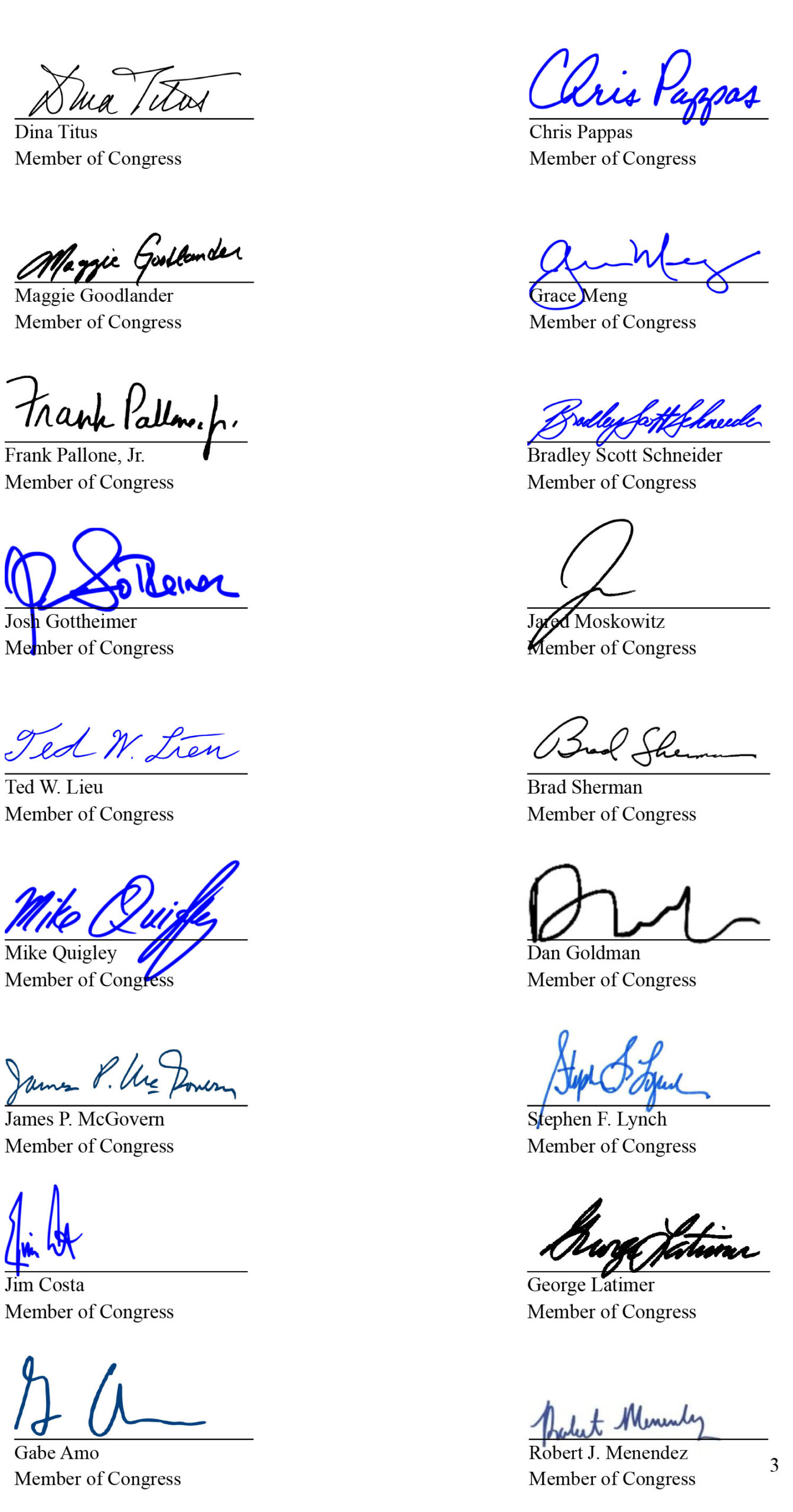
We thank you for your consideration and stand ready to work with your offices on any legislative response.
Sincerely,



 Please wait...